Pizza Ordering Role-Play Scenario

Instructions for Group Practice (Speaking)

About This Activity

Overview

Using a set of Character Preference Cards that provide a set of pizza topping, sauce, and dipping sauce preferences for 18 characters, a group of learners can be challenged to communicate in English to collectively prepare a pizza order that maximizes happiness (and minimizes unhappiness).

Full Prerequisites: Students can participate fully in this Role-Play Activity with all of the activity’s available materials after memorizing/learning:

Materials Available:


  • 1 set of 18 Pizza Preference Cards

Methodological Basis

Role-play Activities are a type of communication practice exercise used regularly under the communicative language teaching (CLT) methodology as one of six common classroom activity types. These activities allow teachers and students to engage in a form of (primarily) verbal communication that approximates authentic real-to-life communication. 

This activity is ideal for learners about a CEFR A2 level (or a more developed CEFR A1 level) who will benefit from a more open-ended opportunity to practice speaking English, while still having some basic core language to fall back on if necessary.

This will aid in encouraging creative speaking efforts, without creating an overly demanding challenge that could lead to learner frustration.

Activity Instructions

Learning Goals

1. Being able to communicate a range of levels of preferences for different pizza toppings, pizza sauces, and dipping sauces.

“I love _________________ on pizza!“

“I like _________________ on pizza.“

“I am OK with _________________ on pizza.“

“I don’t like _________________ on pizza.“

“I hate _________________ on pizza!“


“I love _________________ as a dipping sauce!“

“I like _________________ as a dipping sauce.“

“I am OK with _________________ as a dipping sauce.“

“I don’t like _________________ as a dipping sauce.“

“I hate _________________ as a dipping sauce!“


2. Being able to communicate the logic behind ordering decisions:


“One person doesn’t like bacon on pizza, but 3 people love it. We should order it.“

“Only one person likes BBQ sauce on pizza, but 4 people hate it. We shouldn’t order it. Let’s order tomato sauce instead. Everyone loves, likes, or is OK with tomato sauce on pizza.“


3. Being able finalize a decision.

“Is everyone OK with this order?”

“OK, let’s send the order to the pizza restaurant.”

Assessment

On-Going Self-Assessment:

During each round of role-play, the participants will either reach a successful conclusion — or it won’t. Learners will generally always self-diagnose the miscommunication and figure out how to correct. Due to the personal motivation to get it right, typically, students tend to be proactive in asking a peer or teacher for help with this if they get stuck.

Graduation:

Learners will have achieved the Learning Goals listed above when they can effectively use the target Sentences / Sentence Patterns and Core Vocabulary Words confidently and without hesitation to play either side of a petshop customer service interaction during a practice session with an instructor, or in a practice session with another student while an instructor observes.

Learning Process

1. Introduce the Core Vocabulary Words and encourage the students to learn them. 

2. Demonstrate the use of the activity’s recommended Sentences / Sentence Patterns to communicate important information and make decisions.

3. Allow the students to practice a basic version of the Role-Play Scenario.

4. If the students are comfortable with the basic version, introduce increasingly more complex versions the Role-Play Scenario, such as where two or more different teams compete to score the most points by maximizing the number of happy group members (and minimizing the number unhappy with certain toppings/sauces being included in an order). Teams can gain points for ordering toppings/sauces participants love/like and lose points for ordering toppings/sauces participants dislike/hate.

5. To add extra complexity, prices for different toppings/sauces can be added and spending the least amount of money while maximizing happiness can be introduced as an added goal.

6. During practice, the instructor’s role is to monitor the students’ practice to ensure correct use of the activity’s Sentence Patterns.

7. When students fully achieve the activity’s Learning Goals, the instructor can then graduate the student(s) to a new learning opportunity/activity that further builds on the newly achieved learning.

Notes: 

This role-play activity is only suitable for classes that have at least 4 students, although if there are only 3 students, the instructor could participate as a group member to make the activity more interesting.

Required Resources

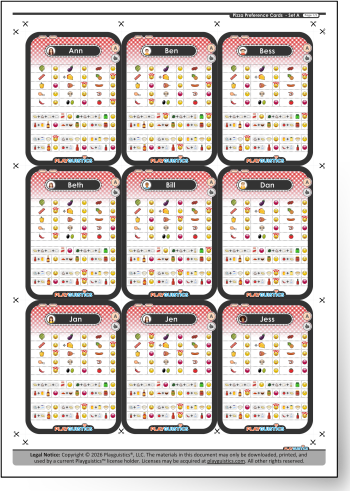
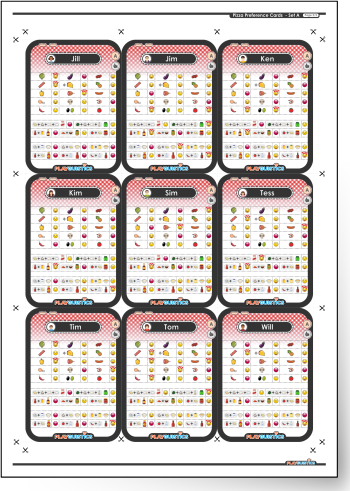
1: Pizza Preference Cards Set A

Each card displays a single character’s preferences for 15 toppings, 5 pizza sauces, and 6 dipping sauces.

Page 1/2 of Set A

Page 1/2 of Set B

Language Content

Sentences & Sentence Patterns Used

The Sentences & Sentence Patterns Used in this activity include everything needed to successfully complete this Role-Play Scenario.

However, there is plenty of room for additions and alterations to the suggested language below, as the language provides is at the most basic level of communication possible, suitable specifically to lower intermediate level learners. Instructors are encouraged to adapt the target language to a level suitable to their students’ current abilities and learning needs.

Sentences & Sentence Patterns

I love _________________ on pizza / as a dipping sauce!

I like _________________ on pizza / as a dipping sauce.

I am OK with _________________ on pizza / as a dipping sauce.

I don’t like _________________ on pizza / as a dipping sauce.

Yes

I hate _________________ on pizza / as a dipping sauce!

__ person doesn’t like _________________ on pizza, but __ people love it. We should order it.

ex. One person doesn’t like bacon on pizza, but 3 people love it. We should order it.

Only __ person/people like(s) _________________ on pizza, but __ people hate it. We shouldn’t order it. Let’s order _________________ instead. Everyone loves, likes, or is OK with _________________ on pizza.

ex. Only one person likes BBQ sauce on pizza, but 4 people hate it. We shouldn’t order it. Let’s order tomato sauce instead. Everyone loves, likes, or is OK with tomato sauce on pizza.

__ person doesn’t like _________________ as a dipping sauce, but __ people love it. We should order it.

Only __ person/people like(s) _________________ as a dipping sauce, but __ people hate it. We shouldn’t order it. Let’s order _________________ instead. Everyone loves, likes, or is OK with _________________ as a dipping sauce.

Is everyone OK with this order?

Yes, we are.

No, I’m not. I want to suggest that we…

…change _________________ to _________________. I don’t like/hate _________________.

Words to Learn Before Playing

The Core Vocabulary Words listed below are all words that students should learn BEFORE attempting the Role-Play Activity described on this page.

Core Vocabulary Words To Pre-Learn

General

numbers 1-10, dipping sauce, pizza, sauce

Pizza Toppings

artichokes, bacon, bell pepper, chicken, chili pepper, eggplant, extra cheese, ham, mushrooms, olives, pepperoni, pineapple, pizza, sausage, shrimp, tomato

Pizza Sauces

alfredo sauce, pesto sauce, barbeque (BBQ) sauce, curry sauce, tomato sauce

Dipping Sauces

blue cheese sauce, garlic butter sauce, honey mustard sauce, buffalo sauce, ketchup, hot sauce

Words to Learn While Playing

The following words will be used to the play this game (with every available set of cards). However, these words don’t need to be pre-taught. These words can and should be learned WHILE playing the game. The instructor’s demonstration of how to play the game will provide an opportunity to show how all of these words are used as part of useful communication sentences.

Vocabulary Best Learned in Context

Used With All Material Sets

a/an, am, are, as, but, change, doesn’t, don’t, everyone, first, fifth, fourth, hate, I, instead, is, it, I’m, let’s, like, likes, love(s), no, not, OK, on, one, only, or, order, person/people, second, should, shouldn’t, suggest, that, third, this, to, want, we, with, yes

Most of the words included on this list are hard (or virtually impossible) to depict visually on a flashcard. Demonstrating them while introducing this Role-Play Activity and then having learners use them while participating in the activity is an optimal strategy for helping learners understand the words’ meaning (based on context/function).

Grammar Points

1. Singular Countable/ Uncountable Article Use

This activity is an excellent opportunity for students to learn about the difference between countable and uncountable nouns, and how to use measure words to count uncountable nouns, with the word food.

“I want a pineapple on the first pizza.”

“I want pineapple on the first pizza.”


“I want pepperonis on the second pizza.”

“I want pepperoni on the second pizza.”