Medical Diagnoses Role-Play

Instructions for Pair Practice (Speaking)

About This Activity

Overview

This Medical Diagnoses Role-Play comes with a set a of materials that provide sufficient structure for CEFR A1 and A2 level learners to productively participate in realistic scenarios using a defined Vocabulary Word List., which includes 9 disease/condition names and 21 symptoms. 

With these materials, students can participate meaningfully in role-play interactions after memorizing as few as 20-30 vocabulary words. Role-play activities are a type of communication practice exercise used regularly under the communicative language teaching (CLT) methodology as 1 of 6 common classroom activity types.

Full Prerequisites: Students can participate fully in this Deduction Challenge with all of the activity’s available materials after memorizing/learning:


Materials Available:


  • 4 different sets of fast-food restaurant role-play props

Methodological Basis

Role-play activities are a type of communication practice exercise used regularly under the communicative language teaching (CLT) methodology as one of six common classroom activity types. These activities allow teachers and students to engage in a form of (primarily) verbal communication that approximates authentic real-to-life communication. 

One our core goals while creating the resources listed on this page was to make authentic role-play speaking activities accessible to even beginners and near-beginners. Many of the available activities are designed to not be open-ended in format, allowing learners to succeed at completing the role-play exercises with a very minimal level of pre-learning required.

This approach aids in building confidence and providing enough repetitions of speaking practice for the learners to make quick progress in their ability to speak English.

Activity Instructions

Learning Goals

1. Gaining basic mastery in using the following sentence pattern and sentence to successfully request diagnostic information:

“What symptoms do you have?”*

“When did your symptoms begin?” 

“Did your symptoms begin suddenly or gradually?


2. Gaining basic mastery in using the following sentence patterns to answer questions about medical symptoms:

“I have _________________, _________________, _________________, and _________________.

“My symptoms started gradually / suddenly.”

“My symptoms began __ minutes / hours / days ago.”


3. Gaining basic mastery in suggesting one or more possible diagnoses:

“Based on your symptoms, I think you might have _________________.”

“Based on your symptoms, I think you might either have _________________ or _________________.”


4. Gaining basic mastery in suggesting one or more possible diagnoses:

“Based on your symptoms, I think you might have _________________.”

“Based on your symptoms, I think you might either have _________________ or _________________.”


5. Gaining basic mastery in providing follow-up treatment information

“For _________________ (condition/disease), symptoms rarely last longer than __ days. So, your symptoms should be gone in __ more days. However, if your symptoms last longer than that, please come back for another visit.”

“I’ll write you a prescription for some medicine.”

“I’ll refer you to an asthma / allergies specialist who can set up schedule some tests to confirm my diagnosis.”

“Pinch your nose just below the hard bump near the top and don’t let go. If the bleeding doesn’t stop in 20-30 minutes, I’ll provide additional treatment.”


6. Learning to use the article “a/an” only for singular nouns and not for uncountable nouns. Being able to differentiate between singular countable noun symptom words and uncountable noun symptom words.

Notes: 

*The use of these very basic (and arguably, not particularly polite sentence patterns) is recommended only for low level beginners. Students who are a little more advanced then that, can be taught more polite language, such as “Are you ready to order?” and “What would you like to have today?” at the instructor’s discretion.

Assessment

On-Going Self-Assessment:

During each round of role-play, the two activity partners can check the Character Card against the Medical Role-Play Diagnostic Table and confirm that the diagnosis is consistent with the symptom information on the Character Card. Due to the personal motivation to get it right, typically, students tend to be proactive in asking a peer or teacher for help with this if they get stuck or disagree about a diagnosis.

Graduation:

Learners will have achieved the Learning Goals listed above when they can effectively use the target Sentences / Sentence Patterns and Core Vocabulary Words confidently and without hesitation to both about communicate about medical symptoms during a practice session with an instructor, or in a practice session with another student while an instructor observes. Students should also be able to demonstrate accurate pronunciation of the 9 diseases/conditions.

Learning Process

1. Introduce the Core Vocabulary Words and encourage the students to learn them. 

2. Demonstrate a successfully completion of the Role-Play Scenario.

3. Allow the students to practice the the Role-Play Scenario in partner-pairs.

4. During practice, the instructor’s role is to monitor the students’ practice to ensure correct use of the activity’s Sentence Patterns.

5. When students fully achieve the activity’s Learning Goals, the instructor can then graduate the student(s) to a new learning opportunity/activity that further builds on the newly achieved learning.

Notes: 

If Cheat Sheets are not utilized, students should be required to demonstrate sufficient memorization of the Core Vocabulary Words before they are approved to participate in the Deduction Challenge activity. 

For classes with only 1 student, the instructor will also need to be the student’s practice partner.

Available Resources

1: Diagnostic Tables

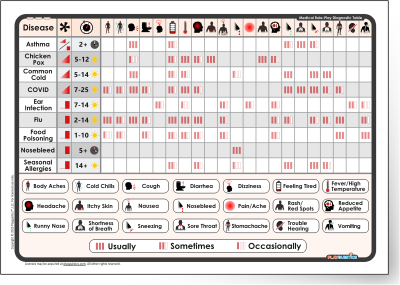
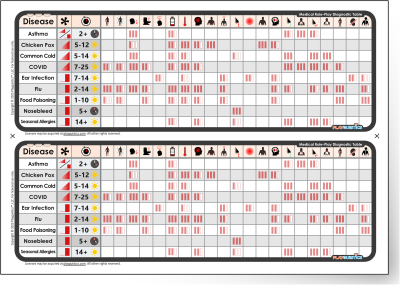
The Diagnostic Tables shown below list all possible diagnoses in the left column and symbols for each possible symptom along the top. If printed and laminated, learners playing the role of doctor can use a whiteboard marker to circle the patient’s symptoms and then gradually cross out the medical diagnoses that don’t match the existing symptoms, until only one or two possible diagnoses remain. 

(Note: Without further testing, flu and food-poisoning cannot always be distinguished based on symptoms alone. This possibility is accounted for in the suggested Sentence Patterns for this activity.)

Instructors may choose to let students begin practicing with a Diagnostic Table with a Symbols Key at the bottom if the students haven’t memorized the meaning of each symbol yet. Students can transition to a Diagnostic Table without a symbols key later after they are more familiar with the 21 symbols along the top.

1x Full Page Diagnostic Table with Symbols Key at the Bottom

2x Diagnostic Tables on one Printable Page without Symbol Keys

2: Medical Symptom (Character) Cards

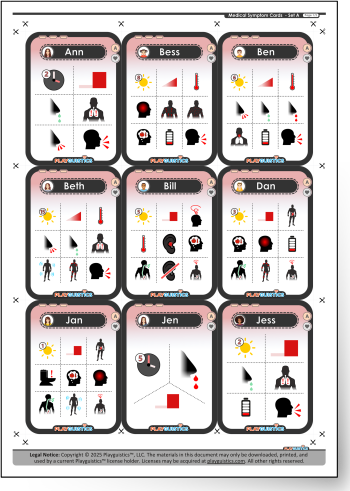
Each of the 18 provided Medical Symptom Cards is specifically designed for one diagnosis (or two possible diagnoses, in the case of flu and food-poisoning). 

Set A Page 1/2

Set A Page 2/2

Language Content

Sentences & Sentence Patterns Used

The Sentences & Sentence Patterns Used in this activity include everything needed to successfully complete this Role-Play Scenario.

However, there is plenty of room for additions and alterations to the suggested language below, as the language provides is at the most basic level of communication possible, suitable only to beginners. Instructors are encouraged to adapt the target language to a level suitable to their students’ current abilities and learning needs.

Supplemental Sentences & Sentence Patterns

What symptoms do you have?

When did your symptoms begin?

Did your symptoms begin suddenly or gradually?

I have _________________, _________________, _________________, and _________________.”

Yes

My symptoms started gradually / suddenly.

My symptoms began __ minutes / hours / days ago.

Based on your symptoms, I think you might have _________________.

Based on your symptoms, I think you might either have _________________ or _________________.

Based on your symptoms, I think you might have _________________.

Based on your symptoms, I think you might either have _________________ or _________________.

For _________________ (condition/disease), symptoms rarely last longer than __ days. So, your symptoms should be gone in __ more days. However, if your symptoms last longer than that, please come back for another visit.

I’ll write you a prescription for some medicine.

I’ll refer you to an asthma / allergies specialist who can set up schedule some tests to confirm my diagnosis.

Pinch your nose just below the hard bump near the top and don’t let go. If the bleeding doesn’t stop in 20-30 minutes, I’ll provide additional treatment.

Words to Learn Before Playing*

The Core Vocabulary Words listed below are all words that students should learn BEFORE attempting the Role-Play Scenario described on this page.

Core Vocabulary Words To Pre-Learn

Materials Set A

(18 Cards)

numbers 1-30, allergies (season allergies), asthma, below, bleeding, body-aches, bump, cold-chills, day, diarrhea, dizzy, ear-ache, fever, gradually, hard, headache, high-temperature, hour, itchy-skin, medicine, minute, nausea, near, nose, nosebleed, pain, pinch, prescription, rash, reduced-appetite, runny-nose, schedule, sneezing, sore-throat, specialist, started, stomache-ache, stop, stop, suddenly, symptoms, tests, think, tired, treatment, trouble-breathing, trouble-hearing, vomiting, write

Notes:

*There is also the option to provide learners with a Cheat Sheet listing all of the Core Vocabulary Words next to their images. This will allow them practice using all of the vocabulary words without needing to first memorize them. The process of learning the words can be scaffolded by first allowing students to use the Cheat Sheet, and then (once they have some familiarity) encouraging them to flip the Cheat Sheet face-down and only use it after first attempting to recall a needed vocabulary word from memory.

Words to Learn While Playing

The following words will be used to the play this game. However, these words don’t need to be pre-taught. These words can and should be learned WHILE playing the game. The instructor’s demonstration of how to play the game will provide an opportunity to show how all of these words are used as part of useful communication sentences.

Vocabulary Best Learned in Context

Used With All Material Sets

a, additional, ago, an, and, another, back, based, be, began, begin, can, come, confirm, diagnosis, did, do, doesn’t, don’t, either, for, gone, have, however, I, I’ll, if, in, just, last, let-go (phrasal verb, not independent words), longer, might, more, my, on, or, please, provide, rarely, refer, set-up (phrasal verb, not independent words), should, so, some, than, that, the, to, top, visit, what, when, who, you, your

Most of the words included on this list are hard (or virtually impossible) to depict visually on a flashcard. Demonstrating them while introducing this Role-Play Scenario and then having learners use them while participating in the activity is an optimal strategy for helping learners understand the words’ meaning (based on context/function).

Grammar Point

1. Singular Countable / Uncountable Article Use

This activity is an excellent opportunity for students to practicing correct article use for countable and uncountable nouns.

“I have headache.”

“I have a headache.”

“I have a body-aches.”

“I have body aches.”

A1 - Medical Symptom Cards

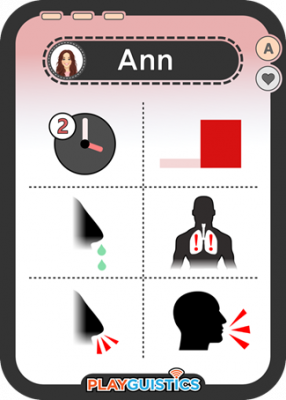
This card shows that Ann’s symptoms began suddenly 2 hours ago, and include a running nose, trouble breathing, sneezing, and coughing.

A11 - Medical Symptom Cards

This card shows that Jim’s symptoms began gradually 4 days ago, and include a running nose, a sore throat, sneezing, as well as feeling tired.

A12 - Medical Symptom Cards

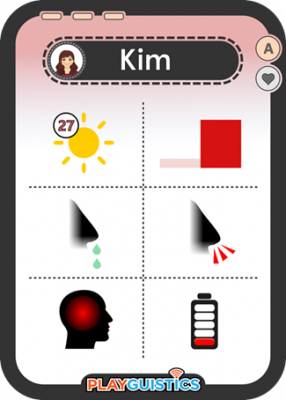
This card shows that Kim’s symptoms began suddenly 27 days ago, and include a running nose, sneezing, a headache, as well as feeling tired.