This is a partner-pair speaking activity for near-intermediate & intermediate level English learners that provides fun, repeated practice of house component vocabulary, such as roof, door, chimney, etc.
It is ideal for learners who have already developed confidence in forming basic sentences, and can benefit from practicing more complex sentences that make use of a variety of adjectives and prepositions to define the location of different house components.
For example, to successfully complete this activity, participants will need to be able to produce verbal descriptions that differentiate the existence of windows on the first story versus on the second story of the house, as well as windows on the left side versus the right side of the house.
The two partners in each partner-pair work together, taking turns being the Participant 1 and Participant 2. For each round, Participant 1 begins by drawing 1 card from the Secret Card Deck.
Then, Participant 2 asks questions (using the provided Core Vocabulary Words and Sentences / Sentence Patterns) and systematically crosses off possibilities on a Deduction Panel until only one option remains.
Minimum Prerequisites: Students can participate fully in this Deduction Challenge with the Set A Materials after memorizing:
Full Prerequisites: Students can participate fully in this Deduction Challenge with all of the activity’s available materials after memorizing/learning:
Deduction Challenges are an excellent example of information-gap activities, which serve as communication practice exercises in both Communicative Language Teaching (CLT) and Task-Based Language Teaching (TBLT). These challenges provide language learners with repeated practice of important sentence patterns and topic-specific vocabulary.
Additionally, since successful completion of the Deduction Challenge task described below relies on accurately communicating information, the activity offers students an excellent opportunity to self-assess their communication accuracy and initiate error-correction themselves.
This is far more efficient and effective than students only knowing that they are making an error if an instructor points it out. It also empowers learners to seek out solutions to mistakes themselves, rather than primarily being passive receivers of teaching and error-correction.
Activity Instructions
Scaffolding Recommendations
1. This activity is not recommended for beginners and near beginners.
Participants in this learning activity should already be able to comfortably ask and answer questions in English with the following sentence pattern and sentences (with no additional pre-teaching required):
“Does your house have (a) _______________?”
“Is this your house?”
“Yes, it does.”
“No, it doesn’t.”
“Yes, it is.”
“No, it isn’t.”
If learners don’t already have basic mastery of the above skills, it is recommended to first use beginner level activities to build this skill, before attempting this activity.
Learning Goals
1. Gaining mastery in asking questions about the number of sections included in window using variations of the following sentence pattern.
“Does your house have a window on the _______________ (left/right) side of the _______________ (first/second) story with _______________ (2/3/4) sections?”
2. Gaining mastery in using the adjectives left and right (with the noun side) and first and second (with the noun floor) to communication the locations of different windows.
“Does your house have (a/two) window(s) on the _______________ (left/right) side of the _______________ (first/second) story?”
3. Gaining mastery in using the adjectives rectangular and half-circle (with the noun window) to describe the shapes of different windows.
4. Gaining mastery in using color adjectives to describe doors, windows, and roofs.
Assessment
On-Going Self-Assessment:
During each round of play, Participant 2 attempts to determine which hairstyle on a Deduction Panel matches the hairstyle on Participant 1’s Secret Card, based only on Participant 1’s answers.
The 2 members of a partner-pair will be able to self-assess their own performance after Participant 2 asks “Is this your hairstyle?” while pointing to a single set of animals on their Deduction Panel.
Participant 1 can then show the Secret Card and the 2 partners can check if their verbal communication was successful. If they failed to successful communicate, they can figure out which mistake they made and then reattempt the Deduction Challenge with a new Secret Card.
Graduation:
Learners will have achieved the Learning Goals listed above when they can consistently complete the Deduction Challenge correctly with any randomly selected Secret Card, while using the target Sentences / Sentence Patterns and Core Vocabulary Wordsconfidently and without hesitation.
3. Allow the students to practice the Deduction Challenge repeatedly.
4. The instructor’s role is to monitor the students’ practice to ensure correct use of the activity’s Sentence Patterns.
5. When students fully achieve the activity’s Learning Goals, the instructor can then graduate the student(s) to a new learning opportunity/activity that further builds on the newly achieved learning.
Notes:
If Cheat Sheets are not utilized, students should be required to demonstrate sufficient memorization of the Core Vocabulary Words before they are approved to participate in the Deduction Challenge activity.
For classes with only 1student, the instructor will also need to be the student’s practice partner.
Required Resources
1:House Cards
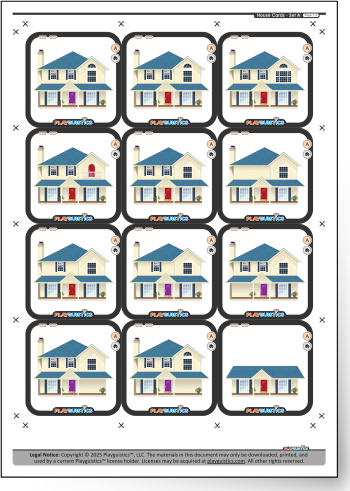
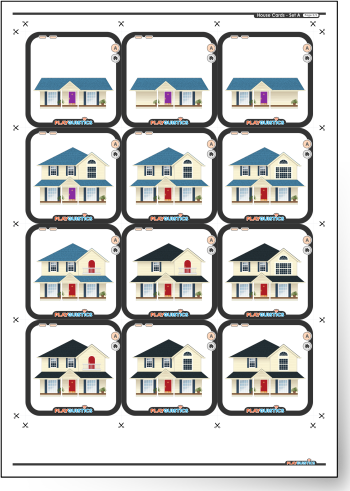
There is 1 sets of 24 cards (labelled Set A) with each card displaying a different combination of house components. For this partner-pair activity, these cards serve as Secret Cards.
Each partner-pair participating in this activity will need 1Secret Card at time, to be held byParticipant 1.
One set of these cards is sufficient for a group of up to 24 activity participants. If there are more than 24participants, then additional cards will need to be added to the secret card deck.
•
For each round of this Deduction Challenge, Participant 1 holds onto a single Secret Card and does not show it to Participant 2 until Participant 2 has narrowed down the choices on their Deduction Panel to just one.
2:Houses Deduction Panels
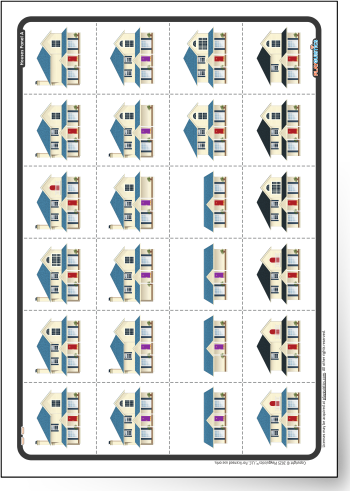
Houses Deduction Panel A shows all of the images on Houses Deduction Cards – Set A on a single “panel.” If laminated, the images on Deduction Panels can be systematically crossed off with an erasable whiteboard marker. After completing a round of this Deduction Challenge, participants can simple wipe the marker marks off of the laminated surface and immediately be ready to repeat the activity.
Each partner-pair participating in this activity will need their own Deduction Panel, for use by Participant 2.
Page 1/2 of Set A of the House Cards
Page 2/2 of Set A of the House Cards
Houses Deduction Panel A with 24 house images
Language Content
Sentences & Sentence Patterns Used
The Sentences & Sentence Patterns Used in this activity include everything needed to successfully complete this Deduction Challenge. While sentences can indeed be composed that would allow for the activity to be completed more efficiently, the provided sentences & sentence patterns below are specifically chosen to maximize learners’ use of the activity’s Core Vocabulary Words.
If the answerer was permitted to simply verbally list the animals shown on their Secret Card, this Deduction Challenge could be completed with a single question and answer. However, by limiting Participant 1’s responses to yes/no answers, Participant 2 must compose more questions than would otherwise be necessary.
Standard Sentences & Sentence Patterns
Does your house have a _______________ (balcony/chimney/second story)?
Does your house have a _______________ (purple/red) door?
Does your house have (a) _______________ (darker/lighter) blue _______________ (roof/roofs)?
Does your house have a window on the _______________ (left/right) side of the _______________ (first/second) story with _______________ (1/2/3/4) sections?
Yes
Does your house have (a/two) window(s) on the _______________ (left/right) side of the _______________ (first/second) story?
Yes
Does your house have a (half-circle/rectangular) window (with __ sections) on the _______________ (left/right) side of the _______________ (first/second) story?
Yes
Yes, it does.
Yes
No, it doesn’t.
Yes
Is this your house?
Yes
Yes, it is.
Yes
No, it isn’t.
Yes
Words to Learn Before Playing*
The Core Vocabulary Words listed below are all words that students should learn BEFORE attempting the Deduction Challenge described on this page.
*There is also the option to provide learners with a Cheat Sheet listing all of the Core Vocabulary Words next to their images. This will allow them practice using all of the vocabulary words without needing to first memorize them. The process of learning the words can be scaffolded by first allowing students to use the Cheat Sheet, and then (once they have some familiarity) encouraging them to flip the Cheat Sheet face-down and only use it after first attempting to recall a needed vocabulary word from memory.
**The two roof colors are intended to be lighter blue and darker blue. However, the actual color may vary based on the printer used. The instructor may need to make adjustments to the vocabulary list to allow learners to accurately describe the roof colors. For example, dark gray might need to be substituted for darker blue.
Words to Learn While Playing
The following words will be used to the play this game (with every available set of cards). However, these words don’t need to be pre-taught. These words can and should be learned WHILE playing the game. The instructor’s demonstration of how to play the game will provide an opportunity to show how all of these words are used as part of useful communication sentences.
Vocabulary Best Learned in Context
Used With All Material Sets
a, does, doesn’t, have, is, isn’t, it, no, of, on, the, this, with, yes, your
Most of the words included on this list are hard (or virtually impossible) to depict visually on a flashcard. Demonstrating them while introducing this Deduction Challenge and then having learners use them while participating in the activity is an optimal strategy for helping learners understand the words’ meaning (based on context/function).
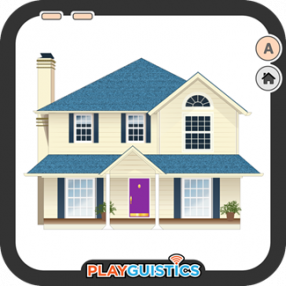
A house with a chimney, a purpledoor, lighter blue roofs, windows on the left side and right side of the first story, 2 windows on the left side of the second story, and 1 half-circle window and 1 rectangular window with 2 sections on the right side of the second story.
A house with a chimney, a reddoor, lighter blue roofs, windows on the left side and right side of the first story, and 1 rectangular window with 2 sections on the right side of the second story.
A house with a reddoor, lighter blue roofs, windows on the left side and right side of the first story, 2 windows on the left side of the second story, and 1 half-circle window and 1 rectangular window with 2 sections on the right side of the second story.
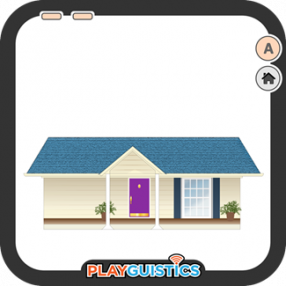
A house with a purpledoor, lighter blue roof, and a window on the right side.
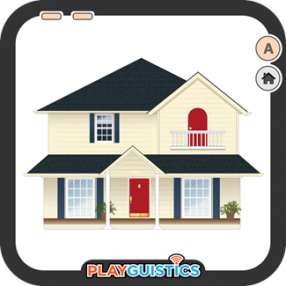
A house with a reddoor, darker blue roofs, windows on the left side and right side of the first story, 1 window on the left side of the second story, and a balcony.
A house with a reddoor, darker blue roofs, windows on the left side and right side of the first story, 2 windows on the left side, and 1 half-circle window and 1 rectangular window with 6 sections on the right side of the second story.