Phonics Fish Card Game

Instructions for Group Activity (Phonics/Vocabulary)

About This Activity

Overview

This is a group activity ideal for giving young learners an immediate reason to learn to recognize alphabet letters and remember which words begin with each sound.

A group of 2 to 8 participants divide a deck of Phonics Fish Cards prepared by an instructor, with vocabulary words pictured that they have already be taught.

The goal is collect sets of 3 to 5 identical cards (how many for a set is at the discretion of the instructor) and be the player with the most sets laid down in front of them when (a player fully empties their hand of cards and) the round is over.

Players collect cards that they need by asking other players, “Do you have a _______________?” Since all of the Phonics Fish Cards have a phonics clue on their back, students who have learned the letters shown will have an advantage when guessing which cards another player has.

Full Prerequisites: Students can participate fully in this Deduction Challenge with all of the activity’s available materials after memorizing/learning:


Materials Available:

  • 16 sets of Phonics Fish Cards covering a variety of topic areas, from which to choose cards to create a Game Deck

Methodological Basis

When young learners are taught phonics knowledge and skills, they don’t fundamentally understand the purpose of what they are learning. Having never experiencing the benefits of being able to read, even if they are told that they are being taught how to read, they will only be able to understand that concept in the abstract.

This game provides an immediate reward for learning the sounds that letters make. Knowing that a ‘b,’ for example, represents the sound that the word ball and bed begin with, will give a player of Phonics Fish an immediate competitive advantage in the game.

Using this game in the classroom, on a regular basis as students learn more letters/phonics sounds, will create an instrinsic motivation to learn phonics in the students. It will therefore be less necessary for instructors to provide extrinsic motiviations to encourage learning.

Activity Instructions

Learning Goals

1. Knowing all of the letters in the alphabet, the sound each one most commonly makes, and several words that begin with that letter/sound. 

Assessment

On-Going Self-Assessment:

During each round of play, all participants will see whether their guesses of what cards are in their fellow game players hands were accurate or not, thereby informing them whether they are correctly remembering the pronunciation of each phonics sound included in the game.

Graduation:

This game is intended to practice and reinforce the use of basic phonics skills, but is not designed to be an activity with a specific graduation criteria. Its purpose is learning and fun, and can continued to be used (with more or different vocabulary words) for as long as an instructor believes that it is providing a learning benefit.

Learning Process

1. Demonstrate how the phonics sound symbols on the back of each card match the beginning phonics sound of the noun depicted on the face of the same card.

2. Demonstrate the rules of the game.

a. To begin, 2 to 8 players must sit in a circle, preferably around a table, although the floor can also be used as a playing surface.

b. 7 cards from the deck of cards is dealt out to each of the 2 to 8 players in a group. The remaining cards are placed in a stack, face-down on the table/floor.

c. The players take turns (in clockwise order) asking someone else in the group, “Do you have a _______________?” with one of the nouns shown in the deck’s cards in the blank.

d. If the player being asked does indeed have 1 of the card they are being asked about, they must say, “Yes, I do.” and hand over the requested card.

e. If the player being asked does not have any of the card they are being asked about, they must say, “No, I don’t. Go fish!” The player who is asking must then draw 1 random card from the top of the stack of cards in the middle of the playing circle.

f. If a player collects 3 of the same card, they may lay the set of 3 down in front of them. (For added challenge, an instructor may wish to require completed sets to be 4 or 5 cards.)

g. Play continues until one player lays down all of the remaining cards in their hand. The winner is the player with the most sets completed and laid down in front of them.

h. During play, player must keep the backs of the cards in their hands visible so that the other players can see the phonics sound symbol on the back of each card.


3. Allow the students to play the game.

4. Normally, the instructor’s main role is to monitor the students’ practice, but they can also play the game, especially initially to demonstrate correct and effective play.

5. Phonics Fish can continued to be used in classes for as long as the instructor believes that it is providing a learning benefit. Due to the wide range of cards available for different vocabulary topics, the game can be re-used with new words when students have learned new words in a new topic/unit, as the game also provides the secondary benefit of vocabulary word recall practice.

Required Resources

1: Double-Sided Phonics Fish Cards

For students to play this game, an instructor must first prepare a deck with a suitable number of cards for the size of the playing group. For a 2 player group, at least 30 cards is recommended. For an 8 player group, at least 90 cards is recommended. The cards must be printed double-sided, so that one side will show the image of a vocabulary word and the other side will show a phonics sound symbol for the beginning phonics sound of the word shown in the image on the other side.

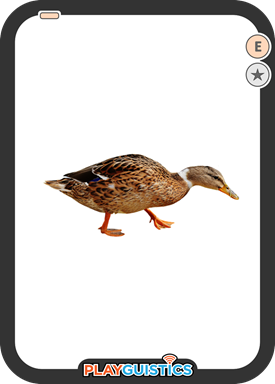
This is the face side of the Phonics Fish card for the word ‘duck.’

This is the back of the Phonics Fish card for the word ‘duck.’

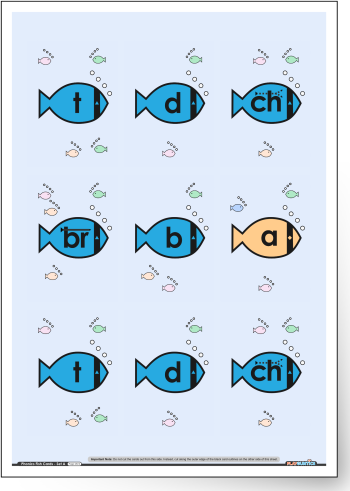
The print sheets for the card backs is designed with plenty of bleed space to ensure that even if the printing is a little out of alignment, the phonics sound symbols will still fully appear on the back of just one card.

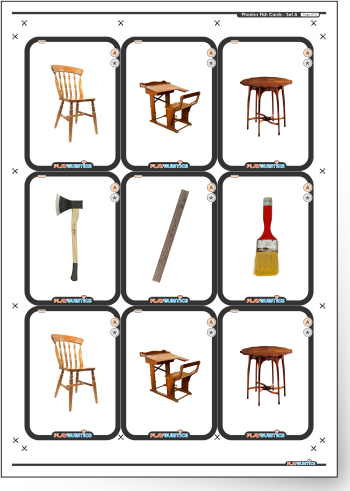
The Faces Side of a Set of Classroom Object Cards

The Backs for the Previous Set of Cards

Language Content

Sentences & Sentence Patterns Used

The Sentences & Sentence Patterns Used in this activity include everything needed to successfully participate in this game.

Sentences & Sentence Patterns & Phrases

Do you have a _______________?

Yes, I do. Here you are.

Thank you.

You’re welcome.

Yes

No, I don’t. Go fish!

I’m out!

I have __ sets.

_______________ has the most sets. He/she is the winner. Good job!

Let’s play again!

We need to shuffle the cards.

Who can shuffle the cards?

I can. / _______________ can shuffle the cards.

Who can deal the cards?

I can. / _______________ can deal the cards.

Words to Learn Before Playing*

The Core Vocabulary Words listed below are all words that students should learn BEFORE attempting playing Phonics Fish with the cards in that printable set described on this page.

Core Vocabulary Words To Pre-Learn

Materials Set A

(18 Cards)

ax, board, brush, chair, desk, table

Materials Set B

(18 Cards)

book, brush, crayon, marker, pen, pencil

Materials Set C

(18 Cards)

crayon, black, blue, brown, gray, green, pink, purple, red, yellow

Materials Set D

(9 Cards)

big, small, gift, blue, brown, purple, red, yellow

Materials Set E

(36 Cards)

alligator, bear, cat, duck, elephant, fish, horse, lion, monkey, octopus, rabbit, turtle

Materials Set F

(9 Cards)

apple, banana, carrot, chili, mushroom, olive, orange, peach, tomato

Materials Set G

(18 Cards)

apartment, barn, cave, house, igloo, nest

Materials Set H

(36 Cards)

boot, dress, glove, hat, helmet, jacket, shirt, shoe, skirt, sock, tie, vest

Materials Set I

(9 Cards)

bike, bus, car, helicopter, plane, school bus, train, van, yacht

Materials Set J

(36 Cards)

arm, ear, elbow, finger, face, head, lip, mouth, nose, thumb, tongue, wing

Materials Set K

(18 Cards)

cube, diamond, rectangle, square, star, triangle

Materials Set L

(18 Cards)

alligator, apple, banana, bear, car, cat, desk, duck, hat, horse, lion, lip, marker, monkey, neck, tomato, van, vest

Materials Set M

(18 Cards)

barn, bike, book, carrot, cookie, cube, face, finger, fish, hamburger, helicopter, helmet, nest, nose, nut, peach, pen, pencil

Materials Set N

(9 Cards)

chair, chili, dress, drink, shirt, shoe, thumb, train, triangle

Materials Set O

(18 Cards)

banana, bear, bike, boot, desk, duck, finger, fish, monkey, mouth, nose, nut, peach, pencil, table, tomato, tongue, turtle

Materials Set P

(18 Cards)

banana, barn, book, desk, duck, face, finger, marker, meatball, mushroom, nest, nut, pen, pizza, tie, turtle, vest, wing

Words to Learn While Playing

The following words will be used to the play this game (with every available set of cards). However, these words don’t need to be pre-taught. These words can and should be learned WHILE playing the game. The instructor’s demonstration of how to play the game will provide an opportunity to show how all of these words are used as part of useful communication sentences.

Vocabulary Best Learned in Context

Used With All Material Sets

a, again, are, can, cards, deal, do, don’t, fish, go, good, has, have, he, here, I, is, I’m, job, let’s, most, need, no, out, play, sets, she, shuffle, thank, the, to, we, welcome, who, winner, yes, you, you’re

Most of the words included on this list are hard (or virtually impossible) to depict visually on a flashcard. Demonstrating them while introducing Phonics Fish and then having learners use them while participating in the activity is an optimal strategy for helping learners understand the words’ meaning (based on context/function).