This is a group speaking practice activity ideal for 3 to 8 participants per group. The difficult level of this activity is perfect for learners at a CEFR A2 level, as it will help learners at that skill level gain expertise with the type of more complex communication needed to graduate to a CEFR B1 level. This activity could also be beneficial for confident CEFR A1 level learners, as it provides the opportunity for more complex speaking/listening practice, without requiring many vocabulary words to be learned first.
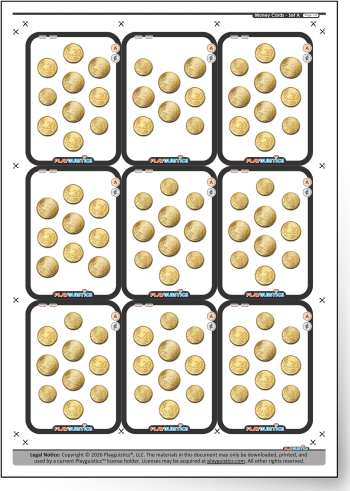
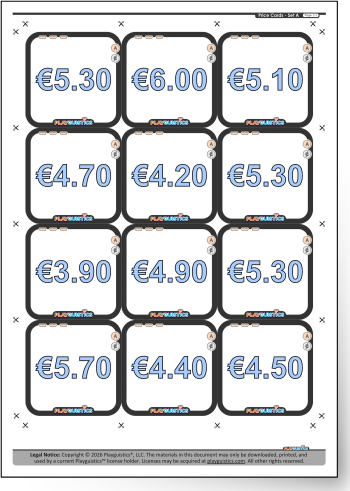
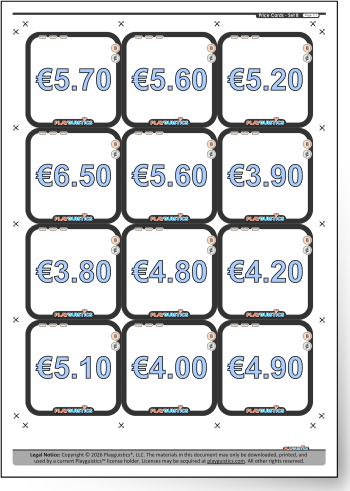
For a group of 3 to 8 participants to play this game, 1 copy of Money Cards Set A and 1 copy of either Price Cards Set A or Set B are required. All of the cards in Price Cards Set A or Set B are placed face-up on the table (or other playing surface) that the team members arrange around. All of the cards in Money Cards Set A are dealt out (as evenly as possible) between the 3 to 8 players in a group.
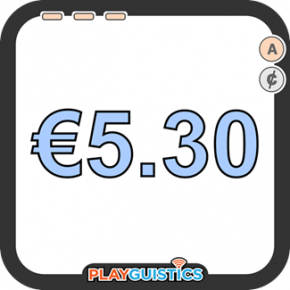
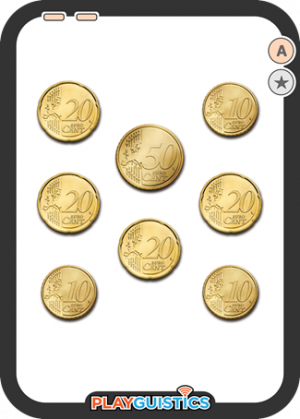
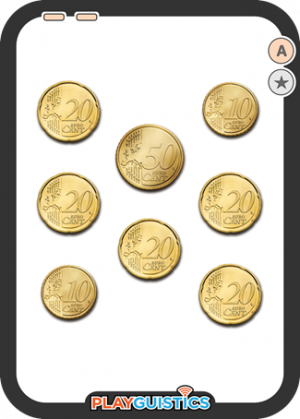
To successfully complete the activity, the Money Cards that collective equal the total currency value of that Price Card must placed be placed in a stack on top of each Price Card. For example the Money Cards shown below have the values of €2.00, €1.60, and €1.70. Together, those values equal the €5.30 value shown on the Price Card above.
However, the players may not show their Money Cards to each other and instead verbally communicate the value shown on each. Therefore, the only way to know which cards are being placed in each stack, is for the players to communicate that information to each other verbally. This necessitates on-going speaking and listening practice for the entire length of every round of play.
Each round of play continues until all of the Money Cards have been placed in stacks on top of the Price Cards. Then the students check their own work for accuracy.
It is recommended to have one player/participant be given the responsibility of using a calculator to do quick calculations for the whole group. That participant should sit somewhere that the other participants can’t see the numbers on the calculator, so that they have no choice but to verbally communicate the results of their calculations.
Full Prerequisites: Students can participate fully in this Collaborative Game with all of the activity’s available materials after memorizing/learning:
Money Cards Set A, containing 27 playing cards. Only one copy needs to be printed for each group of 6 to 8 players.
Price Cards Set A, containing12 mini-square cards each with a different price printed on it. Only 1 copy need to be printed, per group of 6 to 8 players.
Price Cards Set B, containing12 mini-square cards each with a different price printed on it. This set is optional, and can be substituted for Price Cards Set A if the learners become too familiar with Set A and want a new challenge with new prices. Only 1 copy need to be printed, per group of 6 to 8 players.
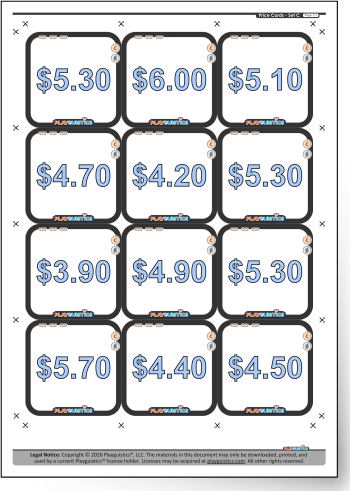
Price Cards Set C, containing12 mini-square cards. Identical to Prices Set A, except with a $ denomination instead of €. Only 1 copy need to be printed, per group of 6 to 8 players.
This Collaborative Game is an excellent example of information-gap activities, which serve as communication practice exercises in both Communicative Language Teaching (CLT) and Task-Based Language Teaching (TBLT). These game tasks provide language learners with repeated practice of important sentence patterns and topic-specific vocabulary.
Additionally, since successful completion of the Collaborate Game described below relies on accurately communicating information, the activity offers students an excellent opportunity to self-assess their communication accuracy and initiate error-correction themselves.
This is far more efficient and effective than students only knowing that they are making an error if an instructor points it out. It also empowers learners to seek out solutions to mistakes themselves, rather than primarily being passive receivers of teaching and error-correction.
Activity Instructions
Learning Goals
1. Achieve the ability to successfully communicate currency values and discuss which currency values, when added together, equal the totals (which are shown on the Price Cards).
“I have _______________ dollars/euros and_______________ cents in coins.”
“I think we need to use 2sets of coins to get the right amount of money for this price.”
“I think we need to use 3sets of coins to get the right amount of money for this price.”
“That will work!”
“That won’t work.”
2. Achieve the ability to reliably understand verbal communication about currency values and prices.
Assessment
On-Going Self-Assessment:
After each round of play (a round ends when all of the Money Card have been grouped into face-down stacks on the table/floor), the 3 to 8 members of a team can then flip over each stack of face-down cards and check to see if they have correctly grouped the right cards together to equal the currency value shown on the corresponding Price Card that the each stack of Money Cards has been placed on top of.
Generally, if mistakes have been made, learners can usually self-diagnose the reason why the mistake was and then perform better on their next attempt at successfully completing the Collaborative Game’s communication task.
Graduation:
An instructor can assess individual learners by laying out all of the Money Cards Set A and Price Cards Set A (or Set B) on a table. Then, the instructor can ask the learner to (with the help of a calculator) describe (verbally, without any pointing) which combination of currency values on the Money Cards are equal to the values shown on different Price Cards specified by the instructor.
2. Demonstrate how to play the Collaborative Game, including use of the Core Vocabulary Wordsand Sentence Patterns for the necessary in-game collaborative communication.
3. Arrange the students into appropriate sized groups of 3 to 8 and get each group set up around a table or other playing surface.
4. Allow the students to play the Collaborative Game. It may be wise for an instructor to initially play the game with them for first round or two. This will provide an opportunity for the instructor to model the correct use of the activity’s Sentence Patterns.
5. If not playing with them, the instructor’s role during game-play, is to monitor the students’ practice to ensure correct use of the activity’s Core Vocabulary Words and Sentence Patterns.
6. When students fully achieve the activity’s Learning Goals, the instructor can then graduate the student(s) to a new learning opportunity/activity that further builds on the newly achieved learning.
Notes:
It is possible to play a 2-person version of this game for one-on-one tutoring classes, but the game is most fun with at least 3 participants per group.
Required Resources
1:Money Cards Set A
There 27 cards included in this set. Only 1 copy needs to be printed and prepared for each group 3 to 8 players.
2:Price Cards Set A
There are 12 cards included in this set. Only 1 copy needs to be printed and prepared for each group 3 to 8 players.
This will not result in “extra” cards being printed.
2:Price Cards Set B (Optional)
The are 12 cards in this set can be substituted for Set A if an instructor wishes believes that their students need some new variety to keep the activity interesting.
2:Price Cards Set C (Optional)
The are 12 cards in this set can be substituted for Set A if an instructor wishes to use a dollar currency instead of euros.
Page 1/3 of Money Cards Set A
Page 2/3 of Money Cards Set A
Page 3/3 of Money Cards Set A
Page 1/1 of Euro Price Cards Set A
Page 1/1 of Euro Price Cards Set B
Page 1/1 of Dollar Price Cards Set C
Language Content
Sentences & Sentence Patterns Used
The Sentences & Sentence Patterns Used in this activity include everything needed to successfully participate in this Collaborative Game.
Standard Sentences & Sentence Patterns
I have _______________ dollars/euros and _______________ cents in coins.
_______________ dollars/euros and _______________ cents plus _______________ dollars/euros and _______________ cents equals _______________ dollars/euros and _______________ cents.
_______________ dollars/euros and _______________ cents plus
_______________ dollars/euros and _______________ cents plus _______________ dollars/euros and _______________ cents equals _______________ dollars/euros and _______________ cents.
I think we need to use 2sets of coins to get the right amount of money for this price.
Yes
I think we need to use 3sets of coins to get the right amount of money for this price.
Yes
That will work.
Yes
That won’t work.
Yes
Words to Learn Before Playing
The Core Vocabulary Words listed below are all words that students should learn BEFORE attempting the Collaborative Game described on this page.
Core Vocabulary Words To Pre-Learn
Price Cards Set A
(12 Cards)
numbers 1-100, cents, coins, euros, equals, money, plus
Price Cards Set B
(12 Cards)
numbers 1-100, cents, coins, euros, equals, money, plus
Price Cards Set C
(12 Cards)
numbers 1-100, cents, coins, dollars, equals, money, plus
Words to Learn While Playing
The following words will be used to the play this game. However, these words don’t need to be pre-taught. These words can and should be learned WHILE playing the game. The instructor’s demonstration of how to play the game will provide an opportunity to show how all of these words are used as part of useful communication sentences.
Vocabulary Best Learned in Context
Used With All Card Sets
amount, and, for, get, have, I, in, is, isn’t, it, need, no, of, price, right (correct), sets, that, the, think, this, to, use, we, will, won’t, work, yes
Most of the words included on this list are hard (or virtually impossible) to depict visually on a flashcard. The optimal strategy for helping learners understand these words is to demonstrate their context/function.
This can be achieved best by using them while introducing this Collaborative Game and then having learners use them while participating in the activity.