Medical Symptoms Deduction Challenge

Instructions for Pair Practice (Speaking)

About This Activity

Overview

This is a partner-pair speaking activity for English beginners that provides fun, repeated practice of common medical symptom vocabulary. It is ideal for learners who are still learning to confidently form basic sentences, but who have already learned at least 200 basic high-frequency words.

The two partners in each partner-pair work together, taking turns being the Participant 1 and Participant 2. For each round, Participant 1 begins by drawing 1 card from the Secret Card Deck. 

Then, Participant 2 asks questions (using the provided Core Vocabulary Words and Sentences / Sentence Patterns) and systematically crosses off possibilities on a Deduction Panel until only one option remains.

Full Prerequisites: Students can participate fully in this Deduction Challenge with all of the activity’s available materials after memorizing/learning:


Materials Available:


  • 1 set of Secret Cards, each with a different combination of Core Vocabulary Words
  • 1 matching Deduction Panel

Methodological Basis

Deduction Challenges are an excellent example of information-gap activities, which serve as communication practice exercises in both Communicative Language Teaching (CLT) and Task-Based Language Teaching (TBLT). These challenges provide language learners with repeated practice of important sentence patterns and topic-specific vocabulary. 

Additionally, since successful completion of the Deduction Challenge task described below relies on accurately communicating information, the activity offers students an excellent opportunity to self-assess their communication accuracy and initiate error-correction themselves. 

This is far more efficient and effective than students only knowing that they are making an error if an instructor points it out. It also empowers learners to seek out solutions to mistakes themselves, rather than primarily being passive receivers of teaching and error-correction. 

Activity Instructions

Learning Goals

1. Gaining basic mastery in using the following sentence pattern and sentence to successfully collect information in English:

“Do you have (a) _______________?”

“Are you having trouble breathing / hearing?”

“Have you been dizzy / feeling tired / sneezing / vomiting?”

“Have you been experiencing these symptoms for __ minutes / hours / days?”

“Did the symptoms start gradually / suddenly?”

“Are you _______________?”


2. Gaining basic mastery in using the following phrases to answer questions accurately:

“Yes, I am.”

“No, I’m not.”

“Yes, I have.”

“No, I haven’t.’

“Yes, I am.”

“No, I’m not.”


3. Be able to pronounce and differentiate the 18 different CVC phonics words for the 18 characters’ names featured in this activity.

4. (Optional) Understand the differences between present simple, present past, present continuous, and present perfect continuous.

Assessment

On-Going Self-Assessment:

During each round of play, Participant 2 attempts to determine which set of character symptom information on a Deduction Panel matches the list of symptoms, illness duration, and speed of onset on Participant 1’s Secret Card, based only on Participant 1’s answers.

The 2 members of a partner-pair will be able to self-assess their own performance after Participant 2 asks “Are you _______________?” (with one of the 18 character’s names inserted in the blank).

Participant 1 can then show the Secret Card and the 2 partners can check if their verbal communication was successful. If they failed to successful communicate, they can figure out which mistake they made and then reattempt the Deduction Challenge with a new Secret Card.

Graduation:

Learners will have achieved the Learning Goals listed above when they can consistently complete the Deduction Challenge correctly with any randomly selected Secret Card, while using the target Sentences / Sentence Patterns and Core Vocabulary Words confidently and without hesitation.

Learning Process

1. Introduce the Core Vocabulary Words and encourage the students to learn them. 

2. Demonstrate the Deduction Challenge activity, including correct use of the Core Vocabulary Words and Sentence Patterns.

3. (Optional) Familiarize the students with the present simple, present continuous, and present perfect continuous verb tenses that will be used repeatedly in the activities question sentences / sentence patterns.

4. Allow the students to practice the Deduction Challenge repeatedly.

5. The instructor’s role is to monitor the students’ practice to ensure correct use of the activity’s Sentence Patterns.

6. When students fully achieve the activity’s Learning Goals, the instructor can then graduate the student(s) to a new learning opportunity/activity that further builds on the newly achieved learning.

Notes: 

If Cheat Sheets are not utilized, students should be required to demonstrate sufficient memorization of the Core Vocabulary Words before they are approved to participate in the Deduction Challenge activity. 

For classes with only 1 student, the instructor will also need to be the student’s practice partner.

Required Resources

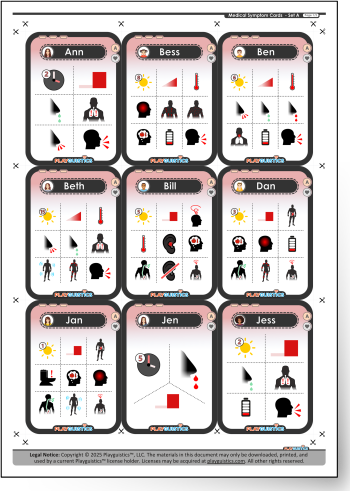
1: Medical Symptom Cards

Each of these cards feature a different combination of medical symptom information for a specific character. For this partner-pair activity, these cards serve as Secret Cards.

There is 1 set of 18 cards, which are labelled Set A.

Each partner-pair participating in this activity will need 1 Secret Card at time, to be held by Participant 1. 

One set of these cards is suitable for a group of up to 36 activity participants. If there are more than 36 participants (18 partner-pairs), then additional cards will need to be added to the secret card deck.

•

For each round of this Deduction Challenge, Participant 1 holds onto a single Secret Card and does not show it to Participant 2 until Participant 2 has narrowed down the choices on their Deduction Panel to just one.


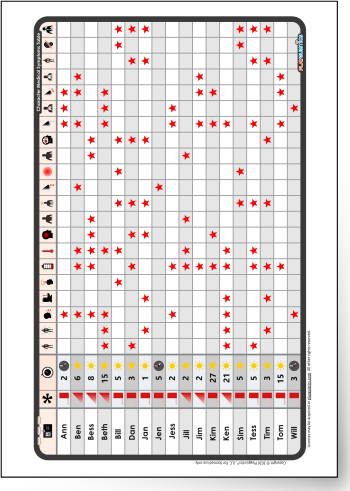
2: Character Medical Symptoms Tables

The Character Medical Symptoms Table feature all of the information from all of the character Medical Symptom Cards on a single one-page table. If laminated, the images on Symptoms Table can be systematically crossed off with an erasable whiteboard marker. After completing a round of the Deduction Challenge, participants can simple wipe the marker marks off of the laminated surface and immediately be ready to repeat the activity. 

Each partner-pair participating in this activity will need their own Character Medical Symptoms Table, for use by Participant 2. 

Medical Symptom Cards Set A Page 1/2

Medical Symptom Cards Set A Page 2/2

Character Medical Symptoms Table

Language Content

Sentences & Sentence Patterns Used

The Sentences & Sentence Patterns Used in this activity include everything needed to successfully complete this Deduction Challenge. While sentences can indeed be composed that would allow for the activity to be completed more efficiently, the provided sentences & sentence patterns below are specifically chosen to maximize learners’ use of the activity’s Core Vocabulary Words. 

If the answerer was permitted to simply verbally list the symptoms shown on their Secret Card, this Deduction Challenge could be completed with a single question and answer. However, by limiting Participant 1’s responses to yes/no answers, Participant 2 must compose more questions than would otherwise be necessary.

Standard Sentences & Sentence Patterns

Do you have (a) _______________?

Are you having trouble breathing / hearing?

Have you been dizzy / feeling tired / sneezing / vomiting?

Have you been experiencing these symptoms for __ minutes / hours / days?

Did the symptoms start gradually / suddenly?

Are you _______________?

Words to Learn Before Playing*

The Core Vocabulary Words listed below are all words that students should learn BEFORE attempting the Deduction Challenge described on this page.

Core Vocabulary Words To Pre-Learn

Materials Set A

(18 Cards)

body-aches, cold-chills, day, diarrhea, dizzy, ear-ache, fever, gradually, headache, high-temperature, hour, itchy-skin, minute, nausea, nosebleed, pain, rash, reduced-appetite, runny-nose, sneezing, sore-throat, stomache-ache, suddenly, tired, trouble-breathing, trouble-hearing, vomiting


Notes:

*There is also the option to provide learners with a Cheat Sheet listing all of the Core Vocabulary Words next to their images. This will allow them practice using all of the vocabulary words without needing to first memorize them. The process of learning the words can be scaffolded by first allowing students to use the Cheat Sheet, and then (once they have some familiarity) encouraging them to flip the Cheat Sheet face-down and only use it after first attempting to recall a needed vocabulary word from memory.

Words to Learn While Playing

The following words will be used to the play this game (with every available set of cards). However, these words don’t need to be pre-taught. These words can and should be learned WHILE playing the game. The instructor’s demonstration of how to play the game will provide an opportunity to show how all of these words are used as part of useful communication sentences.

Vocabulary Best Learned in Context

Used With All Material Sets

a, are, been, did, do, experiencing, feeling, for, gradually, have, having, hearing, start, suddenly, symptoms, the, these, you

Most of the words included on this list are hard (or virtually impossible) to depict visually on a flashcard. Demonstrating them while introducing this Deduction Challenge and then having learners use them while participating in the activity is an optimal strategy for helping learners understand the words’ meaning (based on context/function).

Grammar Points

1. Use of ‘a/an’ as an Article for Singular Nouns

This activity provides the opportunity for learners to practice use ‘a/an’ as an article for singular nouns (and remember to not use if for plural nouns).

The very basic present simple is used for most questions.

Do you have (a) _______________?

Student can be taught that countable singular nouns, like nosebleed, stomach-ache, and reduced-appetite, should be preceded was an ‘a/an’, while uncountable nouns, like diarrhea and itchy-skin, should not.

2. (Optional) Present Simple, Past Simple, Present Continuous, and Present Perfect Continuous

This activity provides the opportunity for contextual exposure to four verb tenses.

The very basic present simple is used for most questions.

Do you have (a) _______________?

The very useful Past Simple, used here to ask a question about something that happened previously, but is not an on-going condition.

“Did the symptoms start gradually / suddenly?”


The more complex Present Continuous, used to communicate a present and on-going condition.

“Are you having trouble breathing / hearing?”

And the less commonly used Present Perfect Continuous, used to communicate that a condition that started previously and is still an on-going (potentially intermittent) condition, often used to also communicate the duration of the period of time that the condition has been experienced for.

“Have you been dizzy / feeling tired / sneezing / vomiting?”

“Have you been experiencing these symptoms for __ minutes / hours / days?”

If an instructor believes their students are not yet ready to learn this Grammar Point, the activity can still be used without providing instruction about the underlying verb conjegation types.

Data - Gradual - 01

gradually

Data - Abrupt - 01

suddenly

Data - Duration - 02

duration

Data - Day - 01

days

Data - Hours - 01

days

Data - Minutes - 01

hours

Symptom - Body Aches - 01

body-aches

Symptom - Cold Chills - 01

cold chills

Symptom - Cough - 01

a cough

Symptom - Diarrhea - 01

diarrhea

Symptom - Dizziness - 01

dizzy

Symptom - Ear Ache - 01

an ear-ache

Symptom - Feeling Tired - 01

feeling tired

Symptom - Fever - 01

a fever / high-temperature

Symptom - Headache - 01

a headache

Symptom - Itchy Skin - 01

itchy-skin

Symptom - Nausea - 01

nausea

Symptom - Nosebleed - 01

a nosebleed

Symptom - Pain - 01

pain / ache

Symptom - Rash - Red Spots - 01

a rash

Symptom - Reduced Appetite - 01

a reduced-appetite

Symptom - Runny Nose - 01

a runny-nose

Symptom - Sneezing - 01

sneezing

Symptom - Shortness of Breath - 01

trouble-breathing

Symptom - Sore Throat - 01

a sore-throat

Symptom - Stomachache - 01

a stomach-ache

Symptom - Trouble Hearing - 01

trouble-hearing

Symptom - Vomiting - 01

vomiting

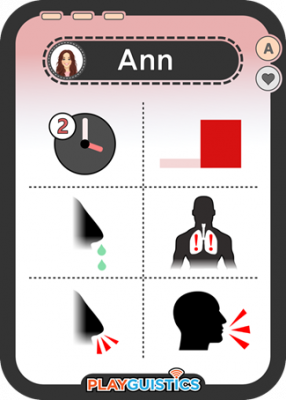
A1 - Medical Symptom Cards

Ann’s symptoms began suddenly 2 hours ago, and include a runny nose, trouble breathing, sneezing, and a cough.

A8 - Medical Symptom Cards

Jen’s symptoms began suddenly 5 minutes ago, and include only a nosebleed, with no additional symptoms.

A11 - Medical Symptom Cards

Jim’s symptoms began gradually 4 days ago, and include a runny nose, a sore throat, sneezing, and feeling tired.