This is a partner-pair speaking activity for English language learners that provides practice of descriptive language. It is ideal for learners who already have a foundation of basic speaking skills, and ready for something with added complexity, but still need a fairly structured activity that they are certain to succeed at.
The two partners in each partner-pair work together, taking turns being the Participant 1 and Participant 2. For each round, Participant 1 begins by drawing 1 card from the Secret Card Deck.
Then, both partners co-operate together with open communication with the provided Core Vocabulary Words and Sentences / Sentence Patterns and Participant 1 attempts to draw an accurate reproduction of the flag shown on Participant 1’s Secret Card.
Minimum Prerequisites: Students can participate fully in this Replication Exercise with all of the activity’s available materials after memorizing/learning:
Full Prerequisites: Students can participate fully in this Replication Exercise with all of the activity’s available materials after memorizing/learning:
Materials Available:
Replication Exercises are an excellent example of information-gap activities, which serve as communication practice exercises in both Communicative Language Teaching (CLT) and Task-Based Language Teaching (TBLT). These challenges provide language learners with repeated practice of important sentence patterns and topic-specific vocabulary.
Additionally, since successful completion of the Replication Exercise task described below relies on accurately communicating information, the activity offers students an excellent opportunity to self-assess their communication accuracy and initiate error-correction themselves.
This is far more efficient and effective than students only knowing that they are making an error if an instructor points it out. It also empowers learners to seek out solutions to mistakes themselves, rather than primarily being passive receivers of teaching and error-correction.
1. Gaining confident mastery in using a variety of Vocabulary Words to describe the layout of a flag.
2. Gaining confident mastery in using a variety of Prepositions, Prepositional Phrases, and Adverbs to describe the layout of a flag.
3. Gaining confident mastery in using a variety of Sentence Patterns to describe the layout of a flag.
On-Going Self-Assessment:
During each round of play, Participant 2 attempts to determine what the flag on Participant 1’s Secret Card looks like based only on Participant 1’s communication, and then replicate it by drawing and coloring.
The 2 members of a partner-pair will be able to self-assess their own performance after Participant 2 completes their drawing and the two partners compare the drawing with the flag on the Secret Card.
Most learners will recognize gaps in their own English skills/knowledge and seek to fill those gaps so that they can perform better on the task.
Graduation:
To ensure that students can consistently complete the Replication Exercise correctly with any randomly selected Secret Card while communicating confidently and without hesitation, an instructor should set the expectation that all students will need to successfully perform the task one-on-one with an instructor before they will be graduated from this activity.
1. Introduce (or review) the Core Vocabulary Words and check the students’ knowledge of them.
2. Demonstrate how English could be used to complete the task. However, don’t demonstrate every possuble utilization of the activity’s suggested language. Leave it to the students’ to make their own efforts to figure out how to utilize the provided Sentence Patterns and Vocabulary Words to complete the task.
3. Allow the students to practice the Replication Exercise repeatedly.
4. The instructor’s role is to monitor the students’ practice. The instructor can provide feedback if a specific language error is made repeated, but generally it is best to allow students to use incorrect grammar, as long as the communication between partner-pairs is understandable to both. Grammar issues can be covertly noted by an instructor and later addressed in lessons specifically designed to practice correctly applying each relevant grammar rule.
5. If students get stuck and are unable to figure out how to describe specific aspects of the flags, an instructor may eventually provide suggestions for how those specific aspects of flag layouts can be verbally communicated. However, it is best if students are able to discover their own solutions, so ideally instuctors will only coach students in the right direction, while still leaving room for the students to have moments of insight. This approach will maximizing their learning and their retention of that learning.
5. When students fully achieve the activity’s Learning Goals by confidently and effectively demonstrating their ability to complete the task one-on-one with the instructor, they can then be graduated to a new learning opportunity/activity that further builds on the newly achieved learning.
Notes:
If Cheat Sheets are not utilized, students should be required to demonstrate sufficient memorization of the Core Vocabulary Words before they are approved to participate in the Replication Exercise activity.
For classes with only 1 student, the instructor will also need to be the student’s practice partner.
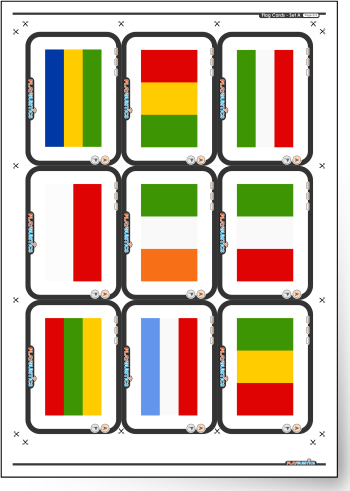
1: Flag Cards
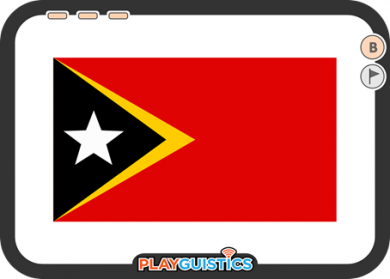
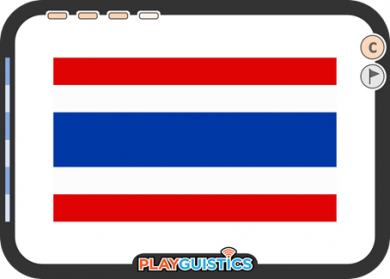
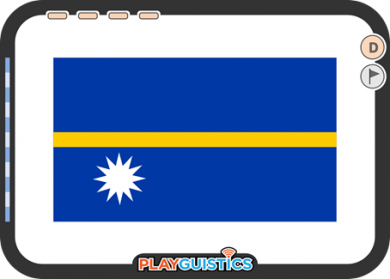
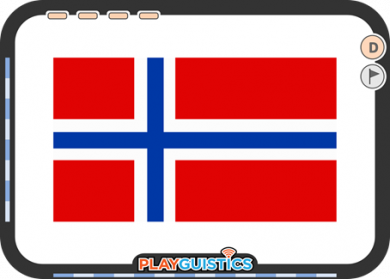
Each of these cards features a different arrangement of colored shapes that form a flag. For this partner-pair activity, these cards serve as Secret Cards.
There are 4 sets available, each with 18 or 27 cards, which are labelled Set A, Set B, Set C, and Set D.
Each partner-pair participating in this activity will need 1 Secret Card at time, to be held by Participant 1.
One set of these cards is suitable for a group of 36 or more activity participants (18 partner-pairs).
•
For each round of this Replication Exercise, Participant 1 holds onto a single Secret Card and does not show it to Participant 2 until Participant 2 has finished drawing a flag.
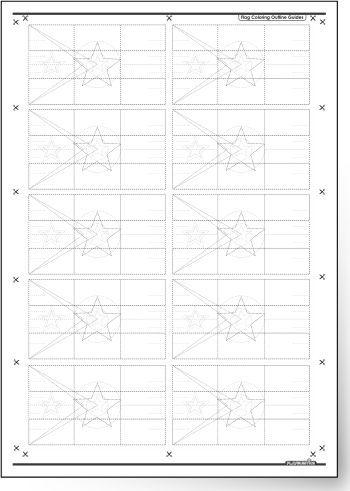
2: Flag Coloring Outline Guide Sheets (Optional)
There are eight Outline Guides available on a single one-page printable. Each page will need to be cut into quarters before use. Each of the Outline Guides feature a flag sized rectangle, with outlines provided for a variety of shapes that occur on at least one flag.
The use of these Outline Guides is optional. Using them will provide structure and may help to reduce frustration for learners, but to increase the challenge level of the activity, an instructor may wish to not provide their students with the Outline Guides. One option is to initially allow students to use the Outline Guides, but later encourage them to go without.
The shape outlines on the Outline Guides are only useful for Flag Cards Sets A, B, and C. The flags on Flag Cards Set D have a level of complexity that extends beyond the shape outlines provided on the Outline Guides.
If utilized, for each round of the activity, each partner-pair participating in this activity will need 1 copy of an Outline Guide, for use by Participant 2.
Page 2/2 of Set A of the Flag Cards
Page 2/2 of Set C of the Flag Cards
10-in-1 Flag Outline Guides Printable
The Sentences & Sentence Patterns Used in this activity include most of the sentences/phrases needed to successfully complete this Deduction Challenge.
An instructor may wish to add additional language content that they know will help their students utilize past learning in a useful way for this communication task.
Sentences & Sentence Patterns & Phrases |
Which colors does the flag include? |
The flag has (a) _______________. |
…3 rectangles beside each other from left to right. |
…2 / 3 rectangles stacked from top to bottom. Yes |
…on top of… |
…in the middle… |
…1 rectangle background. |
…a thin rectangle, in the middle, that goes from left to right. |
…a thin rectangle, a little to the left, that goes from top to bottom. |
…a circle, in the middle, a little to the left. |
…a thin rectangle, in the middle, on top of a slightly thicker rectangle, that both go from left to right. |
…a thin rectangle, a little to the left, on top of a slightly thicker rectangle, that both go from top to bottom. |
…a triangle, that goes from the flag’s two corners on the left side to one point near the flags the middle. |
…a smaller triangle, on top of the other triangle, that goes from the flag’s two corners on the left side to another point near the middle. |
…_______________ on top of a _______________. |
The _______________ is on left/right side of the _______________. |
…_______________ on top of a _______________. |
The circle in the middle doesn’t touch the 2 rectangles at the top and the bottom of the flag. |
…a moon shape. |
…a star with 12 points. |
…5 stars in a (half) circle. |
Where is the star/moon/rectangle/square shape? |
The star/moon/rectangle/square is ____ the height/width of the flag. |
Example: The star is 1/4th the width of the flag. |
Let’s compare the flags. |
We did a good job! |
We made some mistakes. |
The Core Vocabulary Words listed below are all words that students should learn BEFORE attempting the Replication Exercise described on this page.
Core Vocabulary Words To Pre-Learn | |
Materials Set A (27 Cards) | numbers 1-3, background, black, (cornflower) blue, (navy) blue, bottom, flag, green, left, orange, rectangle, red, right (side), top, white, yellow |
Materials Set B (18 Cards) | numbers 1-5, aqua, background, big, black, (cornflower) blue, (navy) blue, bottom, circle, corner, flag, green, half, left, medium-sized, orange, point, rectangle, red, right (side), side, small, star, top, triangle, white, wider, yellow |
Materials Set C (18 Cards) | numbers 1-5, aqua, background, big, black, (cornflower) blue, (navy) blue, bottom, circle, corner, cross, flag, green, half, left, medium-sized, orange, point(s), rectangle, red, right (side), side, small, square, star, top, triangle, white, wider, yellow |
Materials Set D (18 Cards) | numbers 1-10, aqua, background, big, black, (cornflower) blue, (navy) blue, bottom, circle, corner, cross, flag, green, half, left, medium-sized, orange, point(s), rectangle, red, right (side), side, slightly, small, square, star, thicker, thin, top, triangle, white, wider, yellow |

The following words may be used to complete this task. However, these words don’t need to be pre-taught. These words can and should be learned (or potentially reviewed) WHILE playing the game. The instructor’s demonstration of how to play the game will provide an opportunity to show how all of these words are used as part of useful communication sentences.
Learners may also rely on previous learning to utilize words not listed here in unique and creative ways.
Vocabulary Best Learned in Context | |
Used With All Material Sets | a/an, across, and, another, at, beside, both, compare, did, does, doesn’t, each, from, go, goes, good, has, height, in, include, is, job, left, let’s, little, made, mistakes, near, of, on, one, other, right (side), shape, slightly, smaller, some, stacked, that, the, thicker, thin, to, top, touch, we, where, which, width, with, yes |
Most of the words included on this list are hard (or virtually impossible) to depict visually on a flashcard. Demonstrating them while introducing this Replication Exercise and then having learners use them while participating in the activity is an optimal strategy for helping learners understand the words’ meaning (based on context/function).
1. Singular / Plural Article Use & Pluralization with ‘s’
Instructors may choose to use this activity as an opportunity to be vigilant about encouraging correct use of singular articles and pluralizing plural nouns with ‘s.’
This flag has 3 rectangles, stacked on top of each other. The rectangles are red, white, and cornflower blue.
This flag has 2 black and yellow triangles that go from the flag’s 2 corners on the left, to 2 points near the middle of the flag.
This flag has 2 green stars in the middle, 1 a little to the left and 1 a little to the right.
The red rectangles are both 1/6th of the height of the flag. The blue rectangle is 1/3rd of the height of the flag.
The white star with 8 points is about 3/11th of the height of the flag. The yellow rectangle is 1/11th of the height of the flag.
The 2 blue rectangles are both on top of the 2 white rectangles. All of the rectangles are on top of the red background.