These Fast-Food Role-Play Kits are a series of printables that can be cut and glued to form realistic modular role-play props that make it super easy for a teacher to organize authentic restaurant scenarios in a classroom environment.
With these materials, students can participate meaningfully in role-play interactions after memorizing as few as 10-20 vocabulary words. Role-play activities are a type of communication practice exercise used regularly under the communicative language teaching (CLT) methodology as 1 of 6 common classroom activity types.
Minimum Prerequisites: Students can participate fully in this Role-Play Activity with the Set A Materials after memorizing:
Full Prerequisites: Students can participate fully in this Role-Play Activity with all of the activity’s available materials after memorizing/learning:
Role-play Activities are a type of communication practice exercise used regularly under the communicative language teaching (CLT) methodology as one of six common classroom activity types. These activities allow teachers and students to engage in a form of (primarily) verbal communication that approximates authentic real-to-life communication.
One our core goals while creating the resources listed on this page was to make authentic role-play speaking activities accessible to even beginners and near-beginners. Many of the available activities are designed to not be open-ended in format, allowing learners to succeed at completing the role-play exercises with a very minimal level of pre-learning required.
This approach aids in building confidence and providing enough repetitions of speaking practice for the learners to make quick progress in their ability to speak English.
Activity Instructions
Learning Goals
1. Gaining basic mastery in using the following sentence pattern and sentence to successfully request food/beverage orders:
“What do you want?”*
“What do you want to eat?”
“What do you want drink?
“Anything else?”
2. Gaining basic mastery in using the following phrases to provide a restaurant order:
“I want a _________________.”
“I want some _________________.”
“I want more _________________.”
“Yes/No.”
3. Gaining basic mastery in using basic polite language during a food service transaction:
“Here you are.”
“Thank you.”
“You’re welcome.”
4?. (Optional, Materials Set B Only) Learning to use singular/plural verb conjugation forms correctly (is/are) for the verb‘to be.’
Notes:
*The use of these very basic (and arguably, not particularly polite sentence patterns) is recommended only for low level beginners. Students who are a little more advanced then that, can be taught more polite language, such as “Are you ready to order?” and “What would you like to have today?” at the instructor’s discretion.
Assessment
On-Going Self-Assessment:
During each round of role-play, the customer will either get the order they requested correctly delivered — or not. If the order delivered to them is incorrect (not what they wanted to order), learners will generally always self-diagnose the miscommunication and figure out how to correct. Due to the personal motivation to get it right, typically, students tend to be proactive in asking a peer or teacher for help with this if they get stuck.
Graduation:
Learners will have achieved the Learning Goals listed above when they can effectively use the target Sentences / Sentence Patterns and Core Vocabulary Wordsconfidently and without hesitation to both deliver and request a food/beverage order during a practice session with an instructor, or in a practice session with another student while an instructor observes.
2. Demonstrate a basic version of the Role-Play Scenario, including just a small number of the Core Vocabulary Words, such as just “hamburger” and “drink.”
3. Allow the students to practice this initial basic version of the Role-Play Scenario.
4. If the students are comfortable with the basic version, demonstrate a slightly more complex version of the Role-Play Scenario, including a small number of the Core Vocabulary Words, such as “chicken burger” and “fish burger.”
5. Allow the students to practice the Role-Play Scenario in partner-pairs a few times.
6. If the students are comfortable with the slightly more complex version, demonstrate a full-fledged version of the Role-Play Scenario, including a wider variety of the Core Vocabulary Words, including toppings and more, at the instructor’s discretion.
7. Using more and more resources from the 4 provided Role-Play Kits, the instructor can continue to repeat this cycle of demonstrate and practice until students are ultimately able to participate productively in a relatively complex Fast-Food Role-Play Scenarios.
8. During practice, the instructor’s role is to monitor the students’ practice to ensure correct use of the activity’s Sentence Patterns.
9. When students fully achieve the activity’s Learning Goals, the instructor can then graduate the student(s) to a new learning opportunity/activity that further builds on the newly achieved learning.
Notes:
If Cheat Sheets are not utilized, students should be required to demonstrate sufficient memorization of the Core Vocabulary Words before they are approved to participate in the Role-Play Scenario.
For classes with only 1student, the instructor will also need to be the student’s practice partner.
Available Resources
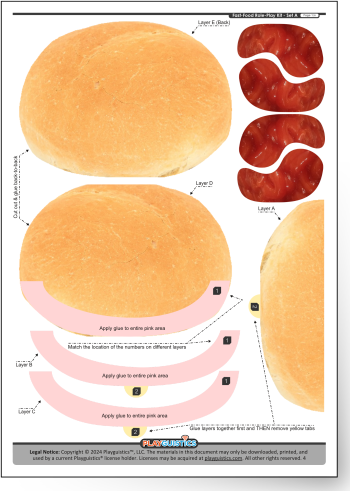
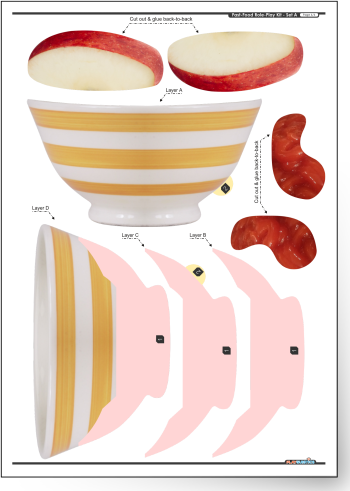
1:Materials Set A
This set includes food only, with basic burger choices, some toppings, and desert option (that can served in the provided bowl. These materials need to be printed on cardstock, then glued together (based on the built-in instructions) to create the functional modular role-play props. An instructor may choose to assemble multiple copies of many of the provided props, to ensure a suitable quantity for the number of students in a class and to allow for sufficient flexibility in role-play scenarios, such as being able to several burgers as part of one order.
Set A Page 1/6
Set A Page 2/6
Set A Page 3/6
1:Materials Set B
This set includes a mug, as well as a variety of beverage inserts that slide into the space inside the mug to make it appear as if the mug is filled with a specific beverage. These materials need to be printed on cardstock, then glued together (based on the built-in instructions) to create the functional modular role-play props. An instructor may choose to assemble multiple copies of many of the provided props, to ensure a suitable quantity for the number of students in a class and to allow for sufficient flexibility in role-play scenarios, such as being able to several different drinks as part of one order.
Set B Page 3/7
Set B Page 4/7
Set B Page 5/7
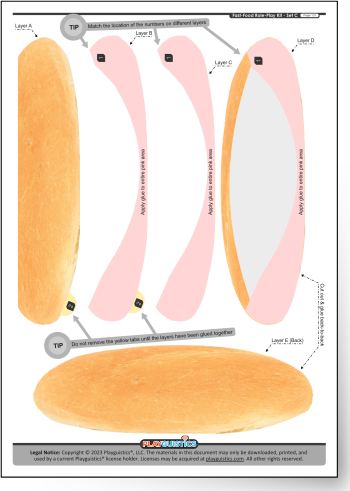
3:Materials Set C
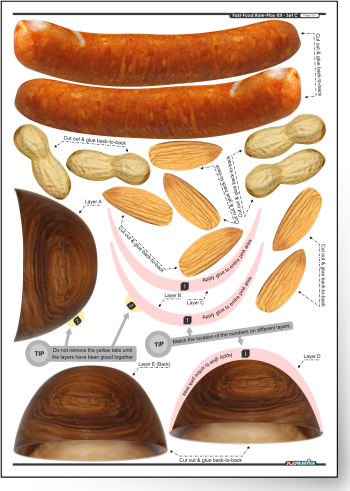
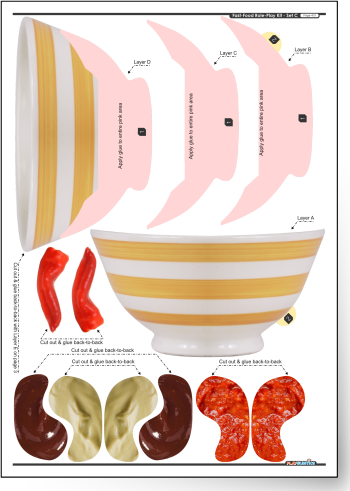
This set includes a hot dog and hot dog bun, as well as nuts, and sauces (that can be placed on hot dogs, hamburgers, and in bowls. These materials need to be printed on cardstock, then glued together (based on the built-in instructions) to create the functional modular role-play props. An instructor may choose to assemble multiple copies of many of the provided props, to ensure a suitable quantity for the number of students in a class and to allow for sufficient flexibility in role-play scenarios, such as being able to several burgers as part of one order.
Set C Page 1/5
Set C Page 2/5
Set C Page 4/5
2:Materials Set D
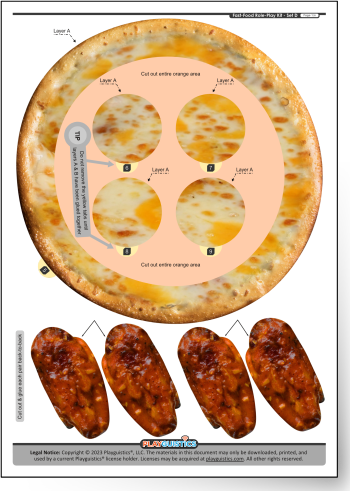
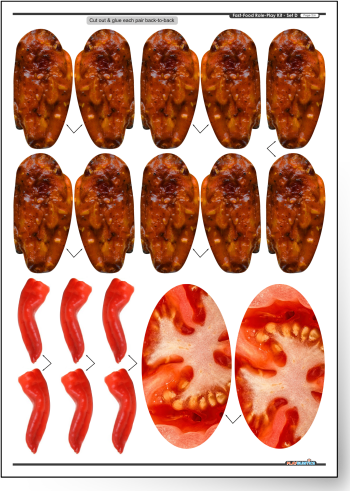
This set includes food only, with basic burger choice, some toppings, and desert option (that can served in the provided bowl. These materials need to be printed on cardstock, then glued together (based on the built-in instructions) to create the functional modular role-play props.
Set D Page 1/5
Set D Page 2/5
Set D Page 4/5
Language Content
Sentences & Sentence Patterns Used
The Sentences & Sentence Patterns Used in this activity include everything needed to successfully complete this Role-Play Scenario.
However, there is plenty of room for additions and alterations to the suggested language below, as the language provides is at the most basic level of communication possible, suitable only to beginners. Instructors are encouraged to adapt the target language to a level suitable to their students’ current abilities and learning needs.
Standard Sentences & Sentence Patterns
What do you want? What do you want to eat? What do you want drink?
I want a _________________. / I want some _________________. / I want more _________________.
Anything else?
Yes. / No.
Yes
Here you are.
Thank you.
You’re welcome.
Some suggested language for possible customer service complaint practice are provided below. This language is offered only as a suggestion and could be adjusted and/or added to at an instructors discretion. Please note that the integration of the following language will require role-play scenarios to include a customer, a server, and a manager.
Supplemental Sentences & Sentence Patterns
There’s a spider in my food/drink!
I want to speak to a manager.
I asked for _________________ on my hamburger, but instead there is _________________ on my hamburger.
I asked for _________________ (food item/drink), but instead I received _________________ (food item/drink).
Yes
My food is cold!
Oh, I’m sorry sir/miss! I’ll fix this right away. My apologizes.
The customer asked for _________________, but he/she got _________________. Can you please fix that for him/her right away?
Words to Learn Before Playing*
The Core Vocabulary Words listed below are all words that students should learn BEFORE attempting the Role-Play Activity described on this page. Students will only need to learn the words listed for a specific set of materials to play to complete the Role-Play Scenario with those materials.
For example, to attempt the Role-Play Scenario with the Set B materials, the students will only need to know the 17 words listed for Materials Set B.
The following Supplementary Vocabulary Words listed below are from the Supplementary Sentences & Sentence Patterns listed above for possible added scenario complexity.
Supplementary Vocabulary Words To Pre-Learn
All Material Sets
cold, customer, fix, food, manager, speak
Notes:
*There is also the option to provide learners with a Cheat Sheet listing all of the Core Vocabulary Words next to their images. This will allow them practice using all of the vocabulary words without needing to first memorize them. The process of learning the words can be scaffolded by first allowing students to use the Cheat Sheet, and then (once they have some familiarity) encouraging them to flip the Cheat Sheet face-down and only use it after first attempting to recall a needed vocabulary word from memory.
**TRIGGER WARNINGArachnophobia: This set of materials contains a role-play prop of a spider. It is recommended that the classroom instructor/facilitator ensure that that all individuals participating/observing in the classroom environment will be comfortable with the use of this prop.
Words to Learn While Playing
The following words will be used to the play this game (with every available set of cards). However, these words don’t need to be pre-taught. These words can and should be learned WHILE playing the game. The instructor’s demonstration of how to play the game will provide an opportunity to show how all of these words are used as part of useful communication sentences.
Vocabulary Best Learned in Context
Used With All Material Sets
a/an, anything else, are, do, here, I, more, on, some, thank you, to, want, what, you, your, you’re welcome
Most of the words included on this list are hard (or virtually impossible) to depict visually on a flashcard. Demonstrating them while introducing this Role-Play Activity and then having learners use them while participating in the activity is an optimal strategy for helping learners understand the words’ meaning (based on context/function).
The following words are the words from the Supplementary Sentences and Sentence Patterns, that would also be best learned in context, rather than pre-learned.
Supplementary Vocabulary Words To Learn in Context
All Material Sets
apologies, asked, away, but, can, for, got, he, her, him, in, instead, is, I’ll, I’m, miss, my, oh, on, please, received, right, she, sir, sorry, that, the, there, there’s, this, yes
Grammar Points
1. Singular Countable/ Uncountable Article Use
This activity is an excellent opportunity for students to learn about the difference between countable and uncountable nouns. The difference can be explained with a demonstration (such as trying to count “how many waters” in a small puddle of water placed on a table or the floor by an instructor) and then students can be taught to us the articles ‘a/an’ for countable singular nouns and ‘some’ for uncountable nouns.
“I want chicken burger.”
“I want a chicken burger.”
“I want a ketchup on my chicken burger.”
“I want some ketchup on the chicken burger.”
2. Plural Countable Noun Pluralization
This activity is well suited to giving students an opportunity to practice differentiating between singular and plural nouns, and using correct pluralization (as well as remembering to not place ‘a/an’ before plural nouns).