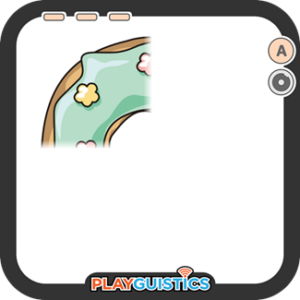
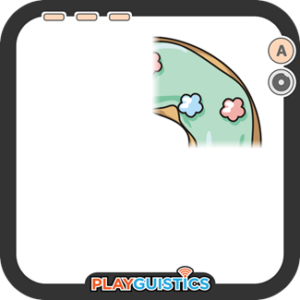
This is a group speaking practice activity ideal for 3 to 8 participants per group (and set of materials). This Collaborative Game is especially suitable for students who already achieved a basic level of speaking confidence & listening comprehension skills, are ready to benefit from some intensive practice verbalizing and trying to understand more complex, multiple-clause sentences.
To play this game, a deck of Donut Game Cards is dealt out (as evenly as possible) between the 3 to 8 players in a group. Then, without showing any of their own cards’ faces to other team members, the players must use spoken English to cooperate in organizing the donut portions into stacks of 2 to 4 cards that each create a single complete donut.
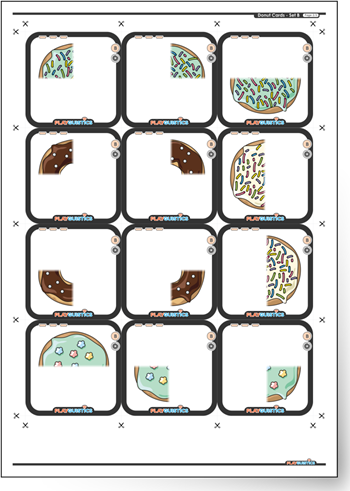
Collectively, the 3 cards shown above form 1 donut with the same shared features, such as mint icing, flower sprinkles, and a hole in the middle. Some donuts are also formed by 2 or 4 cards.
To accomplish this goal, group members must use sentences with a mix of adjectives, prepositions, nouns, and a verb to describe each card they place face-down on the table to create individual, single donut stacks.
Minimum Prerequisites: Students can participate fully in this Collaborative Game with the Set A Materials after memorizing:
Full Prerequisites: Students can participate fully in this Collaborative Game with all of the activity’s available materials after memorizing/learning:
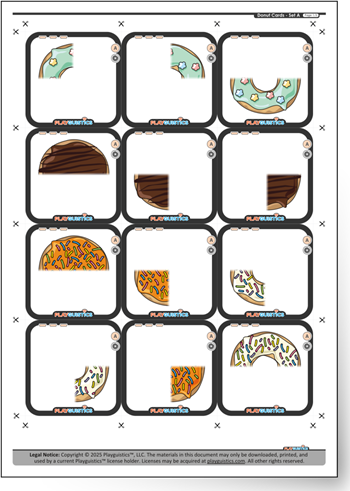
A choice of 3 sets of 24Donut Cards. At the discretion of the instructor, the cards in these sets can be mixed and matched to create custom decks of any size.
This Collaborative Game is an excellent example of information-gap activities, which serve as communication practice exercises in both Communicative Language Teaching (CLT) and Task-Based Language Teaching (TBLT). These game tasks provide language learners with repeated practice of important sentence patterns and topic-specific vocabulary.
Additionally, since successful completion of the Collaborate Game described below relies on accurately communicating information, the activity offers students an excellent opportunity to self-assess their communication accuracy and initiate error-correction themselves.
This is far more efficient and effective than students only knowing that they are making an error if an instructor points it out. It also empowers learners to seek out solutions to mistakes themselves, rather than primarily being passive receivers of teaching and error-correction.
Activity Instructions
Learning Goals
1. Achieve the ability to comfortably form/verbalize grammatically correct sentences that use adjectives, prepositions, nouns, and verbs to describe donuts. This includes using the words left/right and corner/side to describe which part of a donut each portion is.
2. Develop listening comprehension skills that can reliable understand relatively complex, multiple clause sentences that describe specific donuts. This includes being able to understand the use of the words left/right and corner/side to describe which part of a donut each portion is.
Assessment
On-Going Self-Assessment:
After each round of play (a round ends when all of the cards in their deck have been grouped into stacks on the table/floor), the 3 to 8 members of a team can then flip over each stack of face-down cards and check to see if they have correctly grouped the right cards together.
Generally, if mistakes have been made, learners can usually self-diagnose the reason why the mistake was and then perform better on their next attempt at successfully completing the Collaborative Game’s communication task.
Graduation:
An instructor can assess individual learners by showing them several randonly selected Donut Cards one-by-one to see if the learner can quickly and confidently use the activity’s Core Vocabulary Words and Sentence Patterns to accurately describe the donut portion shown on each card.
2. Demonstrate how to play the Collaborative Game, including use of the Core Vocabulary Wordsand Sentence Patterns for the necessary in-game collaborative communication.
3. Arrange the students into appropriate sized groups of 3 to 8 and get each group set up around a table or other playing surface.
4. Allow the students to play the Collaborative Game. They will most like not successfully complete the game on their first attempt and will want to try again.
5. While the students are playing, the instructor’s role is to monitor the students’ practice to ensure correct use of the activity’s Core Vocabulary Words and Sentence Patterns.
6. If multiple non-identical card decks have been prepared from the available 3 sets, when appropriate, rotate the available card decks between groups to expose all students to all of the activity’s Core Vocabulary Words.
7. When students fully achieve the activity’s Learning Goals, the instructor can then graduate the student(s) to a new learning opportunity/activity that further builds on the newly achieved learning.
Notes:
If Cheat Sheets are not utilized, students should be required to demonstrate sufficient memorization of the Core Vocabulary Words before they are approved to participate in the Deduction Challenge activity.
It is possible to play a 2-person version of this game for one-on-one tutoring classes, but the game is most fun with at least 3 participants per group.
Required Resources
1:Donut Cards
There are 3 sets of 24 cards available, labelled Set A, Set B, and Set C. See the Core Vocabulary Words section of this page to see which vocabulary words are depicted in each set.
These card sets can be used to create card decks for this activity. A single set is a suitable for a group 3 to 6 of players, but larger custom decks (for example, by combining Set A and Set B to create a custom deck of 48 cards) can be created for larger groups of 6 to 8 players or to provide a higher challenge level to participants.
Page 1/2 of Set A
Page 2/2 of Set B
Page 2/2 of Set C
Language Content
Sentences & Sentence Patterns Used
The Sentences & Sentence Patterns Used in this activity include everything needed to successfully participate in this Collaborative Game.
Standard Sentences & Sentence Patterns
I have the bottom/topleft/right corner of a donut with a/no hole in the middle, _______________ icing, and _______________ sprinkles/streaks.
I have the bottom/left/right/top half of a donut with a/no hole in the middle, _______________ icing, and _______________ sprinkles/streaks.
I have the bottom/topleft/right corner of the same donut.
I have the bottom/left/right/top half of the same donut.
Yes
This donut is finished.
Yes
Let’s check the stacks.
Yes
We did it right! We won!
Yes
Oh, no! We made a mistake.
Yes
Words to Learn Before Playing*
The Core Vocabulary Words listed below are all words that students should learn BEFORE attempting the Collaborative Game described on this page.
*There is also the option to provide learners with a Cheat Sheet listing all of the Core Vocabulary Words next to their images. This will allow them practice using all of the vocabulary words without needing to first memorize them. The process of learning the words can be scaffolded by first allowing students to use the Cheat Sheet, and then (once they have some familiarity) encouraging them to flip the Cheat Sheet face-down and only use it after first attempting to recall a needed vocabulary word from memory.
Words to Learn While Playing
The following words will be used to the play this game. However, these words don’t need to be pre-taught. These words can and should be learned WHILE playing the game. The instructor’s demonstration of how to play the game will provide an opportunity to show how all of these words are used as part of useful communication sentences.
Vocabulary Best Learned in Context
Used With All Material Sets
a, and, check, did, finished, have, I, in, is, it, let’s, made, mistake, no, of, right (correct), same, stack(s), the, this, we, with, won, yes
Most of the words included on this list are hard (or virtually impossible) to depict visually on a flashcard. The optimal strategy for helping learners understand these words is to demonstrate their context/function.
This can be achieved best by using them while introducing this Collaborative Game and then having learners use them while participating in the activity.
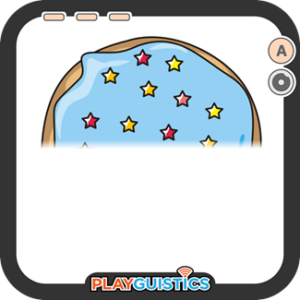
The top half of a donut with no hole in the middle, blueberry icing, & star sprinkles.
The top left corner of a donut with a hole in the middle, mint icing, & flower sprinkles.
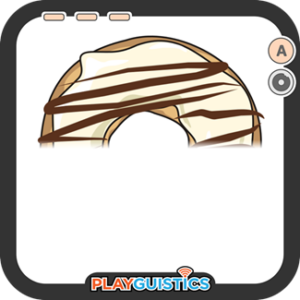
The top half of a donut with a hole in the middle, vanilla icing, & chocolate streaks.
The bottom half of a donut with a hole in the middle, chocolate icing, & chocolate streaks.
The left half of a donut with a hole in the middle, orange icing, & colored sprinkles.
The bottom right corner of a donut with no hole in the middle, strawberry icing, & round sprinkles.