This page lists all of our available Survey Sheet files that involve dessert vocabulary.
The available content includes materials suitable for group sizes ranging from 2 participants (which for 1-on-1 tutoring, could be the student and the teacher) to large group survey activities that can involved a class of 40 or more learners.
Prerequisites: Students can participate in any of the Survey-Taking activities presented on this page after memorizing/learning:
These survey-taking activities are information-gap activities. These activity types are part of the Task-Based Language Teaching (TBLT) methodology.
Due to the simplicity of the communication required for these activities, they are especially suitable for developing speaking confidence in English language beginners and near-beginners. However, they are also an efficient means of quickly developing the speaking skills needed to participate in more complex communication activities that utilize many of the same vocabulary words and similar basic sentence patterns.
Language Content
Sentences & Sentence Patterns Used
The following Sentences & Sentence Patterns are used in all of the survey activities listed on this page.
Standard Sentences & Sentence Patterns
Sentences & Sentence Patterns for Talking About the 18 Characters
Who can you tell me about?
This sentence is primarily for use with the Card-Based Survey Activity, although it can also be used for the Information Trading Survey Activity.
Do you know which desserts _______________ likes and dislikes?
A character’s name goes in the blank.
This sentence is primarily for use with the Information Trading Survey Activity.
_______________ likes _______________.
Yes
A character’s name goes in the first blank. One or more dessert choices go in the second blank.
Yes
_______________ doesn’t like _______________.
Yes
A character’s name goes in the first blank. One or more dessert choices go in the second blank.
Yes
Sentences & Sentence Patterns for Authentic Surveys and Role-Playing as One of the 18 Characters
Yes
Yes
What’s your name?
Yes
This sentence is for use with the Authentic Survey activity version, or the Character Cards Based version, if participants pretend to be the characters shown on their cards.
Yes
My name is _______________.
Yes
For Authentic Surveys the person’s name goes in the blank. For role-playing as one of the 18 characters, a character’s name goes in the blank.
Yes
Which dessert do you like?
Yes
This sentence is for use with the Authentic Survey activity version, or the Character Cards Based version, if participants pretend to be the characters shown on their cards.
Yes
I like _______________.
Yes
One or more dessert choices goes in the blank.
Yes
Which desserts do you dislike?
Yes
This sentence is for use with the Authentic Survey activity version, or the Character Cards Based version, if participants pretend to be the characters shown on their cards.
Yes
I don’t like _______________.
Yes
One or more dessert choices goes in the blank.
Yes
Words to Learn Before Playing*
The Core Vocabulary Words listed below are all words that students should learn BEFORE attempting the Survey Activities described on this page.
*There is also the option to provide learners with a Cheat Sheet listing all of the Core Vocabulary Words next to their images. This will allow them practice using all of the vocabulary words without needing to first memorize them. The process of learning the words can be scaffolded by first allowing students to use the Cheat Sheet, and then (once they have some familiarity) encouraging them to flip the Cheat Sheet face-down and only use it after first attempting to recall a needed vocabulary word from memory.
Words to Learn While Playing
The following words will be used to the play this game (with every available set of cards). However, these words don’t need to be pre-taught. These words can and should be learned WHILE playing the game. The instructor’s demonstration of how to play the game will provide an opportunity to show how all of these words are used as part of useful communication sentences.
Vocabulary Best Learned in Context
Used With All Survey Sheets
about, and, can, dislike, dislikes, do, doesn’t, don’t, I, is, know, like, likes, me, my, name, tell, what, which, who, you, your
Most of the words included on this list are hard (or virtually impossible) to depict visually on a flashcard. Demonstrating them while introducing a Survey-Taking activityand then having learners use them while participating in the activity is an optimal strategy for helping learners understand the words’ meaning (based on context/function).
Instructions for All Activity Types
Learning Goals
1. Gaining mastery in using a variety of sentences to successfully ask about different individuals’ likes and dislikes.
“Do you know which desserts Bethlikes and dislikes?”
“Who can you tell me about?” (This sentence is primarily for use with the Card-Based Survey Activity, although it can also be used for the Information Trading Activity.)
“What’s your name?” (This sentence is for use with the Authentic Survey activity version, or the Character Cards Based version, if participants pretend to be the characters shown on their cards.)
2. Gaining mastery in using sentence patterns to describe different individuals’ likes and dislikes:
“Jill likes cherry pie, ice cream, and ice cream cones.”
“Jim doesn’t like cheesecake, cupcakes, and popsicles.”
Assessment
Self-Assessment:
After ended a round of any of the Survey Activities shown on this page, learners can check their own accuracy by comparing the information they’ve collected on the Survey Sheet to either the Survey Info Table or the Character Cards, depending on which resource their instructor has prepared.
If the information on their Survey Sheet doesn’t match the information on either of those resources, learners will naturally think about why they got it wrong and self-assess the correctness of their speaking/listening.
Given the natural human desire to do things well, learners who recognize that they have made errors will typically seek out help from a classmate or instructor. However, if they don’t, it might be helpful to gently encourage them to do.
Graduation:
Due to only a moderate level of engagement, Survey Activities do not have a high level of repeatability. Therefore, it is recommended to only use the activity types described on this page just one time to initially practice/introduce the included learning content and not set any graduation criteria.
The far more engaging and repeatable Dessert Preferences Deduction Challenge will soon be available to members and will be usable for follow-up practice of comparable learning content.
Finally, if the instructor wishes to, they can use one of the Survey Activities at the end of the learning unit to allow their learners to demonstrate their own progress (and to check if they have reached a sufficient level of mastery for this activity’s Learning Goals).
3. Distribute the required materials and allow the students to complete one of the Survey Activity Types.
4. The activity continues until one or more participants complete their Survey Sheets or until the available activity time has been used up.
5. Have the students check their own work against the available Dessert Preferences Survey Info Tables.
6. Ensure that all students understand how to improve on any mistakes they may have made while asking or answering questions during the activity.
Notes:
If Cheat Sheets are not utilized, students should be required to demonstrate sufficient memorization of the Core Vocabulary Words before they are approved to participate in the Survey activity.
For classes with only 1student, the instructor will also need to be the student’s practice partner.
Activity Versions
1.Authentic Survey
Learners can use this survey-taking activity format to survey real people (classmates, family members, etc) and collect information about their personal preferences on difference job characteristics. The available survey-taking sheets have empty spaces to write names. This type of activity is suitable for environments where students have easy access to sufficient number of people, such as parents, who can answer questions for the survey. In the case of classes with at least 12 participants, an instructor can split the class in half and each half can take turns surveying the members of the other half.
Materials Available:
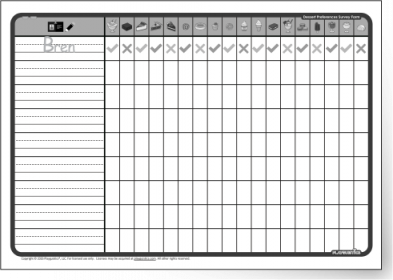
Survey-Taking Sheet with space to take down surveyee’s names and likes & dislikes of 18 dessert choices.
Survey-Taking Sheet with space to take down surveyee’s names and preferences for 18 dessert choices and an example entry on the first line.
Suitable for a class of 12 or more learners (although 16+ is ideal), this survey-taking format uses character cards to ensure that participants get practice giving a wider variety of answers. Instead of answering survey questions based on their own opinions/preferences/situations, the participants answering survey questions play the role of one of the characters featured on the provided character cards and answer questions based on the information on the card that they draw from the deck.
Materials Available:
1 set of 18Dessert Preference Cards, which serve as the activity’s information sources, each with one character’s personal dessert preferences for 18 dessert choices.
Survey-Taking Sheet listing the 18 characters on the Dessert Preference Cards with space to record each character’s likes & dislikes of 18 dessert choices.
Coming Soon
3.Info Table Based Survey
Best for younger and less experienced learners, in this simple format, participants are given a survey form and they can then take turns asking survey questions to one person (usually a teacher), who has a complete Info Table answer key for all 18 characters.
Materials Available:
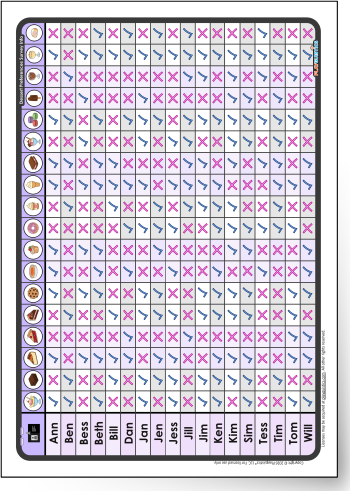
Survey Info Table, each displaying character preference info for 18 dessert choices.
Survey-Taking Sheet listing the 18 characters on the Dessert Preference Cards with space to record each character’s likes & dislikes of 18 dessert.
This is the most efficient format for practicing collecting information, since participants can simultaneous collect and share information. Each participant is given a survey-taking sheet of information with a portion of the information missing. As each sheet features a unique but limited portion of the complete information, activity participants need to circulate around the classroom to find someone with the information they are missing.
Materials Available:
For 2 participants:
1 set of 2Dessert Preference Survey Sheets, with each sheet already showing half of 18 characters’ personal preferences for 18 dessert choices.
For 3-6 participants:
1 set of 6Dessert Preference Survey Sheets, with each sheet already showing 1/3rd of 18 characters’ personal preferences for 18 dessert choices.
For 4-40 participants:
1 set of 40Dessert Preference Survey Sheets, with each sheet already showing 1/4th of 18 characters’ personal preferences for 18 dessert choices.