This is a partner-pair speaking activity for English beginners that provides fun practice of common vehicle and city location vocabulary. It is ideal for providing some engaging fun to lower level learners in a social format, where an entire class plays the game together as a group.
This activity can be repeated several times, but is not ideal for more than 3-5 rounds of play or for differentiated learning.
To play this game, an instructor must prepare a deck of cards, with 2 copies of each card. If there is an odd number of participants, an instructor should participate to make the number of participants even (such as 10 or 12 or 14 or 16, or 18, etc).
All participants (ideally 10 or more) are randomly given 1 card each. All participants must then go around asking each other questions, until they find the other person with the same matching card, without showing anyone their card.
Depending on the instructor’s preferencee, the activity can either continue until 1 match is found – or until all participants have found their match.
Minimum Prerequisites: Students can participate in this Deduction Challenge with the Set A Materials after memorizing/learning:
Full Prerequisites: Students can participate fully in this Deduction Challenge with all of the activity’s available materials after memorizing/learning:
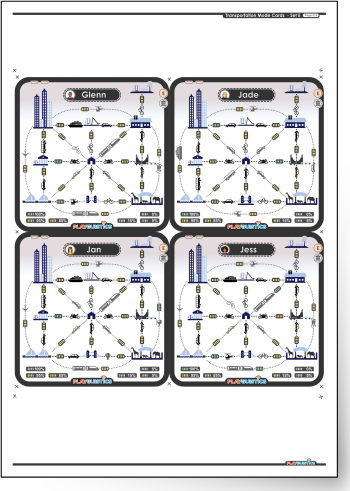
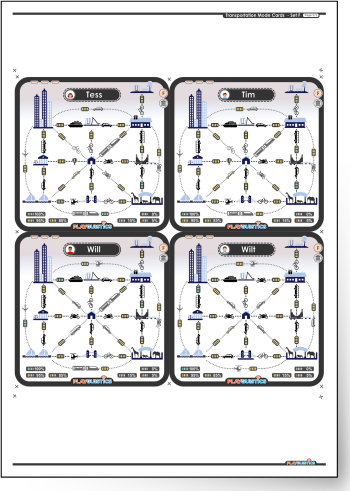
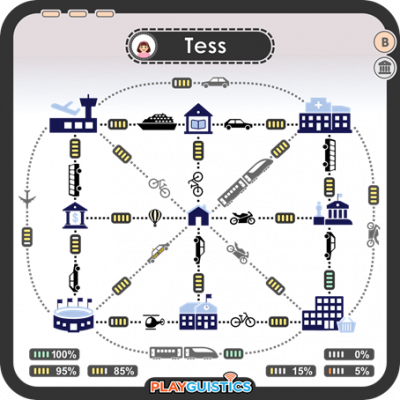
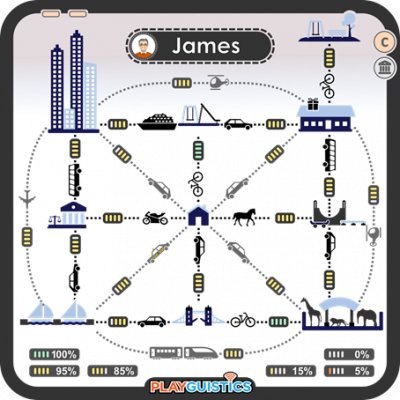
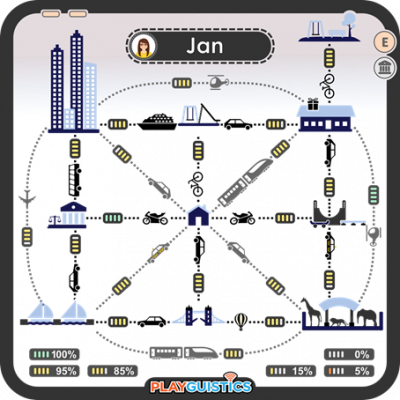
3 sets of 16Transportation Mode Cards (A, C, E) and 3 sets of 8Transportation Mode Cards (B, D, F) each showing a character’s typical mode of transport between a variety of city locations
Deduction Challenges are an excellent example of information-gap activities, which serve as communication practice exercises in both Communicative Language Teaching (CLT) and Task-Based Language Teaching (TBLT). These challenges provide language learners with repeated practice of important sentence patterns and topic-specific vocabulary.
Additionally, since successful completion of the Deduction Challenge task described below relies on accurately communicating information, the activity offers students an excellent opportunity to self-assess their communication accuracy and initiate error-correction themselves.
This is far more efficient and effective than students only knowing that they are making an error if an instructor points it out. It also empowers learners to seek out solutions to mistakes themselves, rather than primarily being passive receivers of teaching and error-correction.
Activity Instructions
Basic Learning Goals
1. Gaining basic mastery in using the following sentence patterns to successfully exchange information in English:
“How do you usually travel from the _______________ (location) to the _______________ (location)?”
“I usually go by _______________ (vehicle type).“
“Oh, we are different.”
“Oh, we are the same!”
“Are you _______________ (name)?
2. Be able to pronounce and differentiate the a variety of different CVC phonics words for up to the 47 characters’ names featured on the cards for this activity.
Optional Supplementary Learning Goals
1. If the cards in Set B, Set D, and/or Set F are used, learners can develop basic mastery in using the following words as adverbs to communicate frequency:
always, usually, often, sometimes, rarely, and never
Learners must be the following sentence patterns with these adverbs to successfully exchange information in English:
Q. “How do you travel from the _______________ (location) to the _______________ (location)?”
A. “I _______________ (frequency) go by _______________ (vehicle type).“
Assessment
On-Going Self-Assessment:
During each round of play, the participants get to see whether their verbal communication has been accurately understood when they check what they believe to be a card-match with another activity participant.
Graduation:
This activity is not recommended as an assessment activity, because as a large group activity, it requires that many learners do the same thing at the same time, even if some of them have already sufficiently learned the content and are ready to move on.
Rather, we would recommend using it to introduce new Vocabulary Words and Sentence Patterns or as a one-time change of pace for students currently practicing similar content with an activity better suited to be an assessment activity.
3. Allow the students to play the game until one or more matches are found. The game can be repeated if student engagement is high.
4. The instructor’s role is to monitor the students’ practice to ensure correct use of the activity’s Sentence Patterns.
5. When students fully achieve the activity’s Learning Goals, the instructor can then graduate the student(s) to a new learning opportunity/activity that further builds on the newly achieved learning.
Notes:
If Cheat Sheets are not utilized, students should be required to demonstrate sufficient memorization of the Core Vocabulary Words before they are approved to participate in the Deduction Challenge activity.
Required Resources
1:Transportation Mode Cards
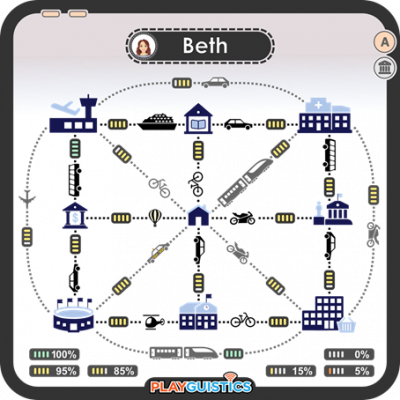
Each of these cards feature character and their transportation mode habits.
Set A, Set C, and Set E each contain16 cards.
Set B, Set D, and Set F each contain8 cards, all of which are the same as 1 or more cards in SetsA, C, and E, other showing a different character and differences in how frequently each transportation method is normally used.
One set of Set A, Set C, or Set Eof these cards is suitable to do this activity with a group of up to 32 activity participants. If there are more than 18 participants, then additional cards will need to be added to the deck from the other available sets.
Page 2/4 of Set A
Page 3/4 of Set E
Page 2/4 of Set F
Language Content
Sentences & Sentence Patterns Used
The Sentences & Sentence Patterns Used in this activity include everything needed to successfully complete this Deduction Challenge. However, sentences can indeed be composed that would allow for the activity to be completed more efficiently. Instructors may wish to use this activity to teach different Sentence Patterns and/or Sentences than the ones suggested below.
As a result, the learners can get enough repeated practice of the sentence patterns to ensure that they become retained in their long-term memory.
Standard Sentences & Sentence Patterns
How do you usually travel from the _______________ (location) to the _______________ (location)?
I usually go by _______________ (vehicle type).
Oh, we are different.
Oh, we are the same!
Yes
Are you _______________ (name)?
Yes
Words to Learn Before Playing*
The Core Vocabulary Words listed below are all words that students should learn BEFORE attempting the Deduction Challenge group activity described on this page.
Core Vocabulary Words To Pre-Learn
All Materials Sets
airplane, bike/bicycle, bus, car, hot air balloon, motorbike, ship, taxi, train, helicopter
Materials Set A
(16 Cards)
airport, bank, hospital, library, museum, school, shopping center, stadium
Materials Set B
(8 Cards)
always, usually, often, sometimes, rarely, never
+ all Set A vocabulary
Materials Set C
(16 Cards)
courthouse, gift shop, marina, old bridge, park, playground, skate park, (the) skyscrapers, zoo
Materials Set D
(8 Cards)
always, usually, often, sometimes, rarely, never
+ all Set C vocabulary
Materials Set E
(16 Cards)
church, factory, fire station, pharmacy, police station, post office, prison, temple
Materials Set F
(8 Cards)
always, usually, often, sometimes, rarely, never
+ all Set E vocabulary
Notes:
*There is also the option to provide learners with a Cheat Sheet listing all of the Core Vocabulary Words next to their images. This will allow them practice using all of the vocabulary words without needing to first memorize them. The process of learning the words can be scaffolded by first allowing students to use the Cheat Sheet, and then (once they have some familiarity) encouraging them to flip the Cheat Sheet face-down and only use it after first attempting to recall a needed vocabulary word from memory.
Words to Learn While Playing
The following words will be used to the play this game. However, these words don’t need to be pre-taught. These words can and should be learned WHILE playing the game. The instructor’s demonstration of how to play the game will provide an opportunity to show how all of these words are used as part of useful communication sentences.
Vocabulary Best Learned in Context
For Materials Set B
are, by, different, do, from, go, how, I, oh, same, the, to, travel, usually, we, you
Most of the words included on this list are hard (or virtually impossible) to depict visually on a flashcard. The optimal strategy for helping learners understand these words is to demonstrate their context/function.
This can be achieved best by using them while introducing this Deduction Challenge and then having learners use them while participating in the activity.
One of the 72Transportation Mode Character Cards that serve as Secret Cards for this activity.
Please note that while the frequency information is different than Beth’s, the transportation modes are identical.
This card features skyscrapers, a gift shop, a playground, a courthouse, an old bridge, a marina, and other locations.
The character names are chosen specifically to provide an opportunity for phonics decoding/encoding practice.